
Organic Molecules
11th Grade
•20 Qs

Similar activities
Ulangan Harian Bioteknologi kelas IX
9th - 12th Grade
•20 Qs
Cell: Structure and Function
11th Grade
•20 Qs
Characteristics of Cells & Functions
KG - University
•20 Qs
Rep, Transcription, Translation
10th - 12th Grade
•20 Qs
3 PostQuiz Cell Transport
9th - 12th Grade
•17 Qs
Proteins, Vitamins, and Minerals
10th - 12th Grade
•15 Qs
2021 Biology Form 5 - Fun Quiz 1
11th Grade
•20 Qs
Cells/Biochemistry
9th - 12th Grade
•20 Qs
Organic Molecules

Quiz
•
Biology
•
11th Grade
•
Practice Problem
•
Medium
Standards-aligned

George Mims
Used 268+ times
FREE Resource

Enhance your content in a minute
20 questions
Show all answers
1.
MULTIPLE CHOICE QUESTION
2 mins • 1 pt
Which organic molecule would a long-distance runner most likely choose to eat before a race?
A protein, because it builds muscle mass.
A carbohydrate, because it gives quick energy.
A lipid, because it stores and releases energy.
A protein, because it transports oxygen in the blood stream.
Answer explanation
A carbohydrate is the best choice for a long-distance runner before a race because it provides quick energy, essential for optimal performance. Proteins and lipids serve different functions and are not ideal for immediate energy needs.
2.
MULTIPLE CHOICE QUESTION
2 mins • 1 pt
Which subunits make up the structure of all proteins?
glucose
amino acids
carbohydrates
phospholipids
Answer explanation
Proteins are made up of amino acids, which are the building blocks that link together in specific sequences to form various proteins. Other options like glucose, carbohydrates, and phospholipids do not constitute protein structure.
Tags
NGSS.HS-LS1-1
3.
MULTIPLE CHOICE QUESTION
30 sec • 1 pt
Which of the following is NOT one of the four major organic molecules?
Lipids
Nucleic Acids
Amino Acids
Carbohydrates
Answer explanation
Amino acids are the building blocks of proteins, not one of the four major organic molecules. The four major organic molecules are lipids, nucleic acids, carbohydrates, and proteins.
4.
MULTIPLE CHOICE QUESTION
30 sec • 1 pt
A ___ is a subunit of an organic molecule.
Monomer
Polymer
Answer explanation
A monomer is a small, basic unit that can join together to form larger molecules called polymers. Therefore, a monomer is the correct answer as it specifically refers to a subunit of an organic molecule.
5.
MULTIPLE CHOICE QUESTION
30 sec • 1 pt
___ stores short-term energy; ___ stores long-term energy.
Carbohydrates; Lipids
Lipids; Carbohydrates
Carbohydrates; Nucleic Acids
Nucleic Acids; Lipids
Answer explanation
Carbohydrates are used for short-term energy storage, providing quick energy for cellular processes. Lipids, on the other hand, serve as long-term energy storage, storing more energy per gram than carbohydrates.
6.
MULTIPLE CHOICE QUESTION
20 sec • 1 pt

Contain C, H, O; used for energy and some plant structures; starch, sugar, cellulose, glycogen.
Lipids
Nucleic acids
Proteins
Carbohydrates
Answer explanation
Carbohydrates contain carbon, hydrogen, and oxygen, and are essential for energy and plant structures. Examples include starch, sugar, cellulose, and glycogen, making 'Carbohydrates' the correct answer.
Tags
NGSS.HS-LS1-6
7.
MULTIPLE CHOICE QUESTION
30 sec • 1 pt

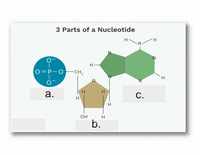
What are the biological molecules in the image?
Carbohydrates
Lipids
Proteins
Nucleic Acids
Answer explanation
The image likely depicts nucleic acids, which include DNA and RNA. These molecules are essential for storing and transmitting genetic information, distinguishing them from carbohydrates, lipids, and proteins.
Tags
NGSS.HS-LS1-1
Access all questions and much more by creating a free account
Create resources
Host any resource
Get auto-graded reports

Continue with Google

Continue with Email

Continue with Classlink

Continue with Clever
or continue with

Microsoft
%20(1).png)
Apple

Others
Already have an account?
Similar Resources on Wayground
16 questions
2023 Solutions, Acids and Bases Test Review
Quiz
•
9th - 12th Grade
15 questions
Bioenergetics vocabulary
Quiz
•
9th - 12th Grade
25 questions
Sistem Ekskresi I
Quiz
•
11th - 12th Grade
20 questions
BİYOLOJİ QUİZ
Quiz
•
9th - 12th Grade
18 questions
Mineral Nutrition
Quiz
•
11th Grade
20 questions
Chapter-3,Plant Kingdom,ALGAE
Quiz
•
11th Grade
17 questions
Levels of Organization and Digestion
Quiz
•
8th - 12th Grade
20 questions
Quiz Gizi Makanan
Quiz
•
11th Grade
Popular Resources on Wayground
15 questions
Fractions on a Number Line
Quiz
•
3rd Grade
20 questions
Equivalent Fractions
Quiz
•
3rd Grade
25 questions
Multiplication Facts
Quiz
•
5th Grade
54 questions
Analyzing Line Graphs & Tables
Quiz
•
4th Grade
22 questions
fractions
Quiz
•
3rd Grade
20 questions
Main Idea and Details
Quiz
•
5th Grade
20 questions
Context Clues
Quiz
•
6th Grade
15 questions
Equivalent Fractions
Quiz
•
4th Grade
Discover more resources for Biology
16 questions
MATZKE Photosynthesis/Respiration
Quiz
•
9th - 12th Grade
10 questions
Quick 10Q: DNA Replication
Quiz
•
9th - 12th Grade
20 questions
Cell Transport
Quiz
•
9th - 12th Grade
7 questions
Plant Reproduction in Angiosperms

Interactive video
•
11th Grade - University
52 questions
Cheetah Reproduction - Mitosis and Genetics
Quiz
•
9th - 12th Grade
25 questions
Unit 1 Formative 1
Quiz
•
9th - 12th Grade
16 questions
Origin of Life
Quiz
•
9th - 12th Grade
7 questions
DNA, Chromosomes, Genes, and Traits: An Intro to Heredity
Interactive video
•
11th Grade - University