
Cell Structure 8.2
Authored by Rebecca Fears
Biology
9th Grade
NGSS covered
Used 88+ times


AI Actions
Add similar questions
Adjust reading levels
Convert to real-world scenario
Translate activity
More...
Content View
Student View
7 questions
Show all answers
1.
MULTIPLE CHOICE QUESTION
30 sec • 1 pt
Which of these structures are present in plant cells, but not animal cells?
cell wall and cell membrane
cell membrane and mitochondria
cell wall and chloroplasts
mitochondria and chloroplasts
2.
MULTIPLE CHOICE QUESTION
30 sec • 1 pt
A student is developing a model to show how most proteins are synthesized in animal cells. Which organelles would be LEAST useful for the student to include in the model?
ribosomes
endoplasmic reticulum
Golgi apparatus
chloroplasts
3.
MULTIPLE SELECT QUESTION
45 sec • 1 pt
The instructions for making proteins are coded in the (cytoplasm / DNA / endoplasmic reticulum / nucleus) of a cell. In a eukaryotic cell, these instructions are located in the (cytoplasm / DNA / endoplasmic reticulum / nucleus).
cytoplasm / endoplasmic reticulum
DNA / nucleus
endoplasmic reticulum / cytoplasm
nucleus / DNA
Tags
NGSS.HS-LS1-1
4.
MULTIPLE CHOICE QUESTION
30 sec • 1 pt
Which cell structure is correctly matched with its function?
vacuole: stores material inside the cell
cell membrane: divides the cell into two halves
lysosome: manufactures proteins
ribosome: packages and modifies proteins
Tags
NGSS.MS-LS1-2
5.
MULTIPLE CHOICE QUESTION
30 sec • 1 pt
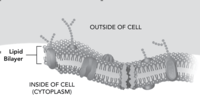
The cell membrane is made up of a lipid bilayer as shown in the model.
Which of the following describes the structure and function of the cell membrane?
The hydrophilic head groups of the lipid molecules are exposed to the outside of the cell and the cytoplasm, which is a water-like environment. The hydrophobic tails form an oily layer inside the membrane that keeps water out of the cell.
The hydrophilic head groups of the lipid molecules are exposed to the outside of the cell and the cytoplasm, which is a water-like environment. The hydrophobic tails form an oily layer inside the membrane that allows water to enter the cell.
The hydrophobic head groups of the lipid molecules are exposed to the outside of the cell and the cytoplasm, which is a water-like environment. The hydrophilic tails form an oily layer inside the membrane that keeps water out of the cell.
The hydrophobic head groups of the lipid molecules are exposed to the outside of the cell and the cytoplasm, which is a water-like environment. The hydrophilic tails form an oily layer inside the membrane that allows water to enter the cell.
6.
MULTIPLE CHOICE QUESTION
30 sec • 1 pt
The pancreas is an organ present in some animals. It produces enzymes that are used in the digestive system of the animal. Which cell structure is likely to be abundant inside pancreas cells?
cell walls, because cell walls cannot be digested by enzymes
chloroplasts, because chloroplasts provide the energy for making enzymes
nuclei, because nuclei contain the instructions for synthesizing enzymes
ribosomes, because enzymes are synthesized on ribosomes
7.
MULTIPLE CHOICE QUESTION
30 sec • 1 pt
A student is comparing the cells of a prokaryote, an animal, and a plant. Identifying which two cell parts would show that the cell was a plant cell, and not a cell of a prokaryote or an animal?
nucleus and mitochondria
cell wall and chloroplast
cell wall and cell membrane
cell membrane and mitochondria
Access all questions and much more by creating a free account
Create resources
Host any resource
Get auto-graded reports

Continue with Google

Continue with Email

Continue with Microsoft
or continue with

%20(1).png)
Apple

Others
By signing up, you agree to our Terms of Service & Privacy Policy
Already have an account?



