
Changing Life (Evidence of Evolution) Reassessment
Authored by Mandi Lueck
Science
7th - 9th Grade
NGSS covered
Used 9+ times


AI Actions
Add similar questions
Adjust reading levels
Convert to real-world scenario
Translate activity
More...
Content View
Student View
20 questions
Show all answers
1.
DRAG AND DROP QUESTION
45 sec • 3 pts

The youngest fossils are located in layer (a) , while the oldest fossils will be located in layer (b) . This is known as the (c) .
Tags
NGSS.MS-ESS1-4
2.
MATCH QUESTION
45 sec • 4 pts
Match the term to the definition:
Similar structures, function may not be
analogous structures
Similar function, structures are not
vestigial structures
Changes to the physical shape
homologous structures
Structures that are no longer used
morphology
Tags
NGSS.MS-LS4-2
3.
MULTIPLE CHOICE QUESTION
45 sec • 1 pt

The picture shows a(n):
homologous structure
vestigial structure
embryonic development
analogous structure
Tags
NGSS.MS-LS4-2
NGSS.MS-LS4-3
4.
MULTIPLE CHOICE QUESTION
45 sec • 1 pt
The opossum and kangaroo both incubate their young in a pouch. This is evidence that they:
are descended from a common ancestor that also had a pouch
have very similar skeletal structures
belong to the same species
must range great distances to eat
Tags
NGSS.MS-LS4-2
5.
MULTIPLE CHOICE QUESTION
45 sec • 1 pt
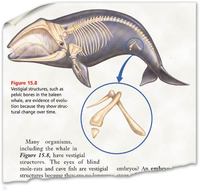
The pelvis of a whale is no longer used making it a vestigial structure. What does it suggest about whales?
It was like humans that also have a pelvis
It had legs and walked on land
It had a pelvis for the tail to help them swim
There is no real connection between modern whales and the pelvis
Tags
NGSS.MS-LS4-2
6.
MULTIPLE SELECT QUESTION
45 sec • 3 pts
Which of the following are evidence of evolution (select ALL that apply):
many animals have homologous structures due to common ancestry
Many animals have vestigial structures from an ancestor
We can observe changes in life forms by observing the fossil record
A person has not grown as tall as their parents but is taller than their grandparents
Tags
NGSS.MS-LS4-2
NGSS.MS-LS4-1
7.
MULTIPLE CHOICE QUESTION
30 sec • 1 pt
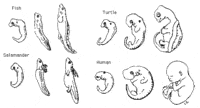
The study of unborn or unhatched organisms to see similarities in development is called:
natural selection
embryology
speciation
evolution
Tags
NGSS.MS-LS4-3
Access all questions and much more by creating a free account
Create resources
Host any resource
Get auto-graded reports

Continue with Google

Continue with Email

Continue with Microsoft
or continue with

%20(1).png)
Apple

Others
By signing up, you agree to our Terms of Service & Privacy Policy
Already have an account?



