
Evolution
Authored by Nera V
Biology
10th Grade
Used 124+ times


AI Actions
Add similar questions
Adjust reading levels
Convert to real-world scenario
Translate activity
More...
Content View
Student View
34 questions
Show all answers
1.
MULTIPLE CHOICE QUESTION
30 sec • 1 pt
The scientific theory of evolution is supported by different types of evidence. The diagrams below show the skeletons of two different animal species. How does comparing the skeletons of these animals provide support for the scientific theory of evolution?
2.
MULTIPLE CHOICE QUESTION
30 sec • 1 pt
According to fossil records, the horses that lived 50 million years ago were much smaller, weaker and slower than modern horses. Which process is most likely responsible for the changes that have led to the increased size, strength, and speed in horses?
3.
MULTIPLE CHOICE QUESTION
30 sec • 1 pt

The diagram illustrates an embryonic stage of two organisms.Which of the following can be determined by observing the embryos shown in the diagram?
4.
MULTIPLE CHOICE QUESTION
30 sec • 1 pt

Scientists have found evidence that about 2.4 million years ago a gene regulating jaw muscles mutated and may have led to the more graceful human jaw we see today. The diagram below shows the skulls of 3 hominid species.Which statement below most closely explains the link between jaw size and hominid evolution?
5.
MULTIPLE CHOICE QUESTION
30 sec • 1 pt
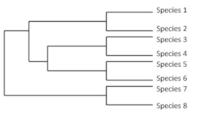
Scientists are studying the evolutionary history of a group of plants in the United States, and they developed an evolutionary tree, as shown below.Which statement can be inferred from the evolutionary tree?
6.
MULTIPLE CHOICE QUESTION
30 sec • 1 pt

Scientists are studying the evolutionary history of a group of plants in the United States, and they developed an evolutionary tree, as shown below.What information about the organisms best helps the scientists to determine the evolutionary relationships among them?
7.
MULTIPLE CHOICE QUESTION
30 sec • 1 pt
When organisms are better adapted to their environment they will survive and reproduce more successfully than organisms less adapted. This process is called what?
Selective breeding
Natural Selection
Cloning
Evolution of all species

Access all questions and much more by creating a free account
Create resources
Host any resource
Get auto-graded reports

Continue with Google

Continue with Email

Continue with Classlink

Continue with Clever
or continue with

Microsoft
%20(1).png)
Apple

Others
Already have an account?
Similar Resources on Wayground

35 questions
Respiratory System

Quiz
•
9th - 12th Grade
30 questions
Meiosis
Quiz
•
9th - 12th Grade
36 questions
#8 Biology Keystone 2: Ecology
Quiz
•
9th - 12th Grade
30 questions
DNA, RNA, & Proteins
Quiz
•
9th - 12th Grade
30 questions
Ecology Review
Quiz
•
9th - 12th Grade
30 questions
DNA, RNA and Protein Synthesis
Quiz
•
9th - 10th Grade
36 questions
Kennisbasis Domein D E F
Quiz
•
10th - 11th Grade
35 questions
Animals!
Quiz
•
9th - 12th Grade
Popular Resources on Wayground
15 questions
Fractions on a Number Line
Quiz
•
3rd Grade
20 questions
Equivalent Fractions
Quiz
•
3rd Grade
25 questions
Multiplication Facts
Quiz
•
5th Grade
22 questions
fractions
Quiz
•
3rd Grade
20 questions
Main Idea and Details
Quiz
•
5th Grade
20 questions
Context Clues
Quiz
•
6th Grade
15 questions
Equivalent Fractions
Quiz
•
4th Grade
20 questions
Figurative Language Review
Quiz
•
6th Grade
Discover more resources for Biology
20 questions
Cell Organelles
Quiz
•
10th Grade
7 questions
Amoeba Sisters Dihybrid Cross Punnett Square

Interactive video
•
9th - 12th Grade
10 questions
Comparing Mitosis and Meiosis: Key Differences and Stages
Interactive video
•
6th - 10th Grade
5 questions
Sex Linked Traits
Interactive video
•
10th Grade
30 questions
Evolution and Taxonomy Review
Quiz
•
10th Grade
10 questions
Cell Structure and Function Concepts
Interactive video
•
6th - 10th Grade
10 questions
Quick 10Q: DNA Replication
Quiz
•
9th - 12th Grade
51 questions
2026 Evolution 2 REVIEW
Quiz
•
10th Grade