
5.6.21 - AP Biology - Water Potential
Authored by Danielle Daniels
Biology
12th Grade
Used 2+ times


AI Actions
Add similar questions
Adjust reading levels
Convert to real-world scenario
Translate activity
More...
Content View
Student View
10 questions
Show all answers
1.
MULTIPLE CHOICE QUESTION
2 mins • 1 pt
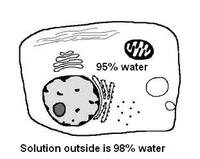
After examining this diagram showing the concentration of water inside and outside of the cell, identify the tonicity of the solution.
hypertonic
hypotonic
isotonic
2.
MULTIPLE CHOICE QUESTION
2 mins • 1 pt

Nemo and other ocean dwelling fish cannot survive in freshwater because......
freshwater is hypertonic to Nemo's cells and will result in water leaving them causing the cells to shrink
freshwater is hypotonic to Nemo's cells and will result in water leaving them causing the cells to shrink
freshwater is hypertonic to Nemo's cells and will result in water entering them causing the cells to swell and burst
freshwater is hypotonic to Nemo's cells and will result in water enter them causing the cells to swell and burst
3.
MULTIPLE CHOICE QUESTION
2 mins • 1 pt
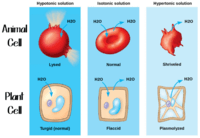
Elodea is a freshwater plant. When it is placed in saltwater what will happen to its cells?
They will become turgid because water is entering the cell, making them firm
They will become flaccid because water is entering and leaving the cell at equal rates, making them a little soft
They will be plasmolyzed because water is leaving the cell, making them shrink significantly
4.
MULTIPLE CHOICE QUESTION
3 mins • 1 pt

The following questions refer to an experiment in which a dialysis-tubing bag is filled with a mixture of 3% starch and 3% glucose and placed in a beaker of distilled water, as shown below. After 3 hours, glucose can be detected in the water outside the dialysis-tubing bag, but starch cannot.
If, instead of the bag, a potato slice were placed in the beaker of distilled water, which of the following would be true of the potato slice?
It would gain mass.
It would neither gain nor lose mass.
It would absorb solutes from the surrounding liquid.
It would lose water until water potential inside the cells is equal to zero.
5.
MULTIPLE CHOICE QUESTION
5 mins • 1 pt
If a cells = 3 bars and its = -4.5 bars, what is the resulting ?
-7.5
7.5
-1.5
1.5
6.
MULTIPLE CHOICE QUESTION
5 mins • 1 pt
The cell with is a of -2.0 bars is placed in a beaker of sugar water with of -4.0 bars. In which direction will the net flow of water be?
Out of the cell
Into the cell
Both into and out of the cell
Neither into nor out of the cell
7.
MULTIPLE CHOICE QUESTION
10 mins • 1 pt
A plant cell with a of -7.5 bars keeps a constant volume when immersed in an open-beaker solution that has a of -4 bars. What is the cells ?
-4
-7.5
-3.5
3.5


Access all questions and much more by creating a free account
Create resources
Host any resource
Get auto-graded reports

Continue with Google

Continue with Email

Continue with Classlink

Continue with Clever
or continue with

Microsoft
%20(1).png)
Apple

Others
Already have an account?

