
Gene Regulation
Authored by Susan Smith
Biology
9th - 12th Grade
NGSS covered
Used 98+ times


AI Actions
Add similar questions
Adjust reading levels
Convert to real-world scenario
Translate activity
More...
Content View
Student View
26 questions
Show all answers
1.
MULTIPLE CHOICE QUESTION
1 min • 1 pt
what does a promoter do?
2.
MULTIPLE CHOICE QUESTION
30 sec • 1 pt
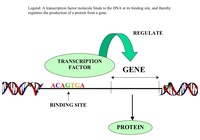
In eukaryotes, proteins that help the RNA polymerase bind to the regulatory region for transcription are called ____________.
Tags
NGSS.HS-LS1-1
3.
MULTIPLE CHOICE QUESTION
45 sec • 1 pt
Which of the following statements regarding mRNA is correct?
Tags
NGSS.HS-LS1-1
4.
MULTIPLE CHOICE QUESTION
30 sec • 1 pt
How can a person's muscle cells have the same exact DNA sequences as their nerve cells even though the look and perform completely different?
Tags
NGSS.HS-LS1-1
NGSS.HS-LS1-4
5.
MULTIPLE CHOICE QUESTION
30 sec • 1 pt
In eukaryotic cells, after transcription, the mRNA
exits the nucleus unchanged.
is processed before leaving the nucleus.
enters the nucleus.
is replicated before leaving the nucleus.
6.
MULTIPLE CHOICE QUESTION
30 sec • 1 pt
In eukaryotic cells, the ____________ are segments of mRNA that are cut out of the final transcript.
promoters
poly A tails
exons
introns
7.
MULTIPLE CHOICE QUESTION
30 sec • 1 pt
What is added to the processed mRNA transcript in eukaryotic cells to help the transcript attach to ribosomes and to be prevented from being broken down?
the exon
the intron
the poly A tail
the cap
Access all questions and much more by creating a free account
Create resources
Host any resource
Get auto-graded reports

Continue with Google

Continue with Email

Continue with Microsoft
or continue with

%20(1).png)
Apple

Others
By signing up, you agree to our Terms of Service & Privacy Policy
Already have an account?


