
Final fun1
Authored by Amanda Pierman
Chemistry, Science
10th Grade
Used 2+ times


AI Actions
Add similar questions
Adjust reading levels
Convert to real-world scenario
Translate activity
More...
Content View
Student View
12 questions
Show all answers
1.
MULTIPLE CHOICE QUESTION
30 sec • 1 pt

This symbol indicates a _______.
neutron
proton
electron
2.
MULTIPLE CHOICE QUESTION
20 sec • 1 pt
Which of the following is described as the basic unit of matter?
3.
MULTIPLE CHOICE QUESTION
30 sec • 1 pt

What charge does an electron have?
4.
MULTIPLE CHOICE QUESTION
30 sec • 1 pt

In this chemical equation, the elements in red are the_______.
Products
Reactants
Subscripts
Coefficients
5.
MULTIPLE CHOICE QUESTION
1 min • 1 pt
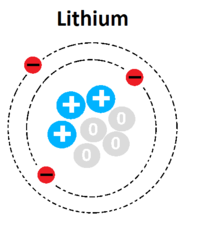
What is the atomic mass of this atom?
1
3
4
7
6.
MULTIPLE CHOICE QUESTION
30 sec • 1 pt
What is a valence electron?
7.
MULTIPLE CHOICE QUESTION
1 min • 1 pt

An ionic bond forms when
valence electrons are shared back and forth (move between) two atoms.
a sea of mobile electrons surround the cations and they then become negativly charged
valence electrons are transferred from one atom to another, forming charged ions that are then pulled together by attraction between opposite charges
none of the above


Access all questions and much more by creating a free account
Create resources
Host any resource
Get auto-graded reports

Continue with Google

Continue with Email

Continue with Classlink

Continue with Clever
or continue with

Microsoft
%20(1).png)
Apple

Others
Already have an account?
Similar Resources on Wayground

10 questions
Chemistry Regent - June 2013 Q31-40

Quiz
•
9th - 12th Grade
10 questions
Redox Balancing Practice (acid solution)
Quiz
•
10th - 12th Grade
11 questions
Ulangkaji
Quiz
•
9th - 10th Grade
15 questions
Molar Mass Concept I
Quiz
•
10th Grade
10 questions
EARTH'S ATMOSPHERIC LAYERS
Quiz
•
10th - 11th Grade
11 questions
Electrostatic Basics Inv 1&2 Review
Quiz
•
8th - 10th Grade
15 questions
check your chemistry vocalbulary
Quiz
•
9th - 12th Grade
10 questions
Soil Types
Quiz
•
9th - 12th Grade
Popular Resources on Wayground
8 questions
2 Step Word Problems
Quiz
•
KG - University
20 questions
Comparing Fractions
Quiz
•
4th Grade
15 questions
Fractions on a Number Line
Quiz
•
3rd Grade
20 questions
Equivalent Fractions
Quiz
•
3rd Grade
25 questions
Multiplication Facts
Quiz
•
5th Grade
10 questions
Latin Bases claus(clois,clos, clud, clus) and ped
Quiz
•
6th - 8th Grade
22 questions
fractions
Quiz
•
3rd Grade
7 questions
The Story of Books
Quiz
•
6th - 8th Grade
Discover more resources for Chemistry
20 questions
Unit 7 Chemical Reactions
Quiz
•
10th Grade
20 questions
Elements, Compounds, and Mixtures
Quiz
•
10th Grade
20 questions
Practice: E-Con, Orbital Notation, Noble Gas Notation
Quiz
•
10th Grade
20 questions
Stoichiometry Practice
Quiz
•
10th Grade
22 questions
Periodic Trends Freshman
Quiz
•
10th Grade
23 questions
Unit 7 Chemical Reactions
Quiz
•
10th Grade
20 questions
Periodic Trends
Quiz
•
10th Grade
13 questions
Mole Conversions
Quiz
•
9th - 12th Grade