
Periodic Table Basics
Authored by Heather Glazebrook
Science
6th - 9th Grade
NGSS covered
Used 12+ times


AI Actions
Add similar questions
Adjust reading levels
Convert to real-world scenario
Translate activity
More...
Content View
Student View
20 questions
Show all answers
1.
MULTIPLE CHOICE QUESTION
30 sec • 5 pts
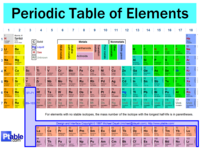
Which group of the periodic table is composed of inert (not reactive) gases?
2.
MULTIPLE CHOICE QUESTION
30 sec • 5 pts
Elements in a ..................have similar chemical properties.
3.
MULTIPLE CHOICE QUESTION
30 sec • 5 pts
Name this group: These metals are the most reactive.


Tags
NGSS.MS-PS1-2
4.
MULTIPLE CHOICE QUESTION
30 sec • 5 pts
Name this group: These metals contain familiar metals such as gold, iron, and copper.


5.
MULTIPLE CHOICE QUESTION
30 sec • 5 pts
Metals that are the most reactive have the following characteristics
small atomic radius, high ionization energy, high electronegativity
large atomic radius, high ionization energy, low electronegativity
large atomic radius, low ionization energy, low electronegativity
small atomic radius, low ionization energy, low electronegativity
Tags
NGSS.HS-PS1-1
NGSS.HS-PS1-2
6.
MULTIPLE CHOICE QUESTION
1 min • 5 pts
As you move down the periodic table atoms get bigger. This is because ____________.
7.
MULTIPLE CHOICE QUESTION
30 sec • 5 pts
The mass number is the sum of what two parts of an atom?
proton and neutron
proton and electron
electron and netron
none of the above
Access all questions and much more by creating a free account
Create resources
Host any resource
Get auto-graded reports

Continue with Google

Continue with Email

Continue with Classlink

Continue with Clever
or continue with

Microsoft
%20(1).png)
Apple

Others
Already have an account?
Similar Resources on Wayground

20 questions
Cell Organelles

Quiz
•
8th - 10th Grade
15 questions
IS_Unit9_Checkpoint 9.2_E
Quiz
•
7th Grade
20 questions
What is Science/Science in Action
Quiz
•
6th Grade
17 questions
Heat (NT Science)
Quiz
•
7th Grade
18 questions
IS_Unit10_Checkpoint 10.5_E
Quiz
•
7th Grade
15 questions
Unit 4 Explore 3 concept review
Quiz
•
6th Grade
19 questions
States of Matter Quiz
Quiz
•
7th Grade
15 questions
Pop Science: DNA
Quiz
•
8th - 12th Grade
Popular Resources on Wayground
15 questions
Fractions on a Number Line
Quiz
•
3rd Grade
20 questions
Equivalent Fractions
Quiz
•
3rd Grade
25 questions
Multiplication Facts
Quiz
•
5th Grade
22 questions
fractions
Quiz
•
3rd Grade
20 questions
Main Idea and Details
Quiz
•
5th Grade
20 questions
Context Clues
Quiz
•
6th Grade
15 questions
Equivalent Fractions
Quiz
•
4th Grade
20 questions
Figurative Language Review
Quiz
•
6th Grade
Discover more resources for Science
33 questions
Grade 6 Quarter 3 PMA 5 Review
Quiz
•
6th - 8th Grade
85 questions
Midpoint D1 Review
Quiz
•
8th Grade
20 questions
Rocks and The Rock Cycle
Quiz
•
6th Grade
12 questions
Ecological Succession
Quiz
•
7th Grade
12 questions
Newton's Laws of Motion

Lesson
•
6th - 8th Grade
10 questions
Exploring the Rock Cycle: Types and Formation

Interactive video
•
6th - 8th Grade
10 questions
Exploring the Layers of the Earth
Interactive video
•
6th - 10th Grade
20 questions
Pure Substances & Mixtures
Quiz
•
8th Grade