
Unit 3 Review
9th - 12th Grade
•26 Qs

Similar activities
Alloys and metal
8th - 9th Grade
•22 Qs
Unit 16 - End of Unit Review Quiz!
9th - 12th Grade
•22 Qs
Solutions
10th - 11th Grade
•25 Qs
Elements PCC Y8-10
7th - 12th Grade
•22 Qs
Elements 10-30
7th - 12th Grade
•21 Qs
Honors Biology Test Study Guide Unit 1
9th - 10th Grade
•21 Qs
21 Questions about the periodic table
7th - 12th Grade
•21 Qs
02D Quiz - Nadtoka
9th Grade - University
•21 Qs

Unit 3 Review

Quiz
•
Chemistry
•
9th - 12th Grade
•
Hard

Joel Morales
Used 28+ times
FREE Resource

Enhance your content in a minute
26 questions
Show all answers
1.
MULTIPLE CHOICE QUESTION
30 sec • 5 pts
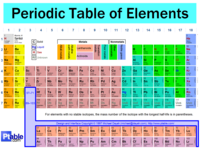
The vertical (up and down) columns in the Periodic Table are called
groups
towers
periods
atomic numbers
2.
MULTIPLE CHOICE QUESTION
30 sec • 5 pts
Which group of the periodic table is composed of inert (not reactive) gases?
3.
MULTIPLE CHOICE QUESTION
30 sec • 5 pts
Which is an alkali metal?
4.
MULTIPLE CHOICE QUESTION
30 sec • 5 pts
Which of the following will have a larger atomic radius than Zinc?
Gallium
Aluminum
Magnesium
Strontium
5.
MULTIPLE CHOICE QUESTION
30 sec • 5 pts
As you move down a group, atomic radius increases because -
6.
MULTIPLE CHOICE QUESTION
30 sec • 5 pts
Francium (Fr) has the lowest ionization energy in Group 1 because -
it has the smallest number of valence electrons
it has the greatest atomic mass
it has the greatest number of protons, so it attracts its electrons the strongest
its 1 valence electron is very far from the nucleus with a lot of shielding from the nucleus, so little energy is needed to remove it
7.
MULTIPLE CHOICE QUESTION
30 sec • 5 pts
Which of the following will have a lower ionization energy than Scandium (Sc)?
Access all questions and much more by creating a free account
Create resources
Host any resource
Get auto-graded reports

Continue with Google

Continue with Email

Continue with Classlink

Continue with Clever
or continue with

Microsoft
%20(1).png)
Apple

Others
Already have an account?
Similar Resources on Wayground
21 questions
Enthalpy
Quiz
•
11th Grade
21 questions
Environmental Factors Affecting Plant Growth
Quiz
•
10th Grade
21 questions
Electrochemistry Quiz
Quiz
•
12th Grade
21 questions
Periodic Trends - Revision
Quiz
•
10th Grade
21 questions
Air quality and air pollution
Quiz
•
9th - 12th Grade
21 questions
atomic structure
Quiz
•
9th - 11th Grade
25 questions
Solutions
Quiz
•
9th - 12th Grade
23 questions
Kinetics: Chemistry's Demolition Derby
Quiz
•
9th - 12th Grade
Popular Resources on Wayground
15 questions
Fractions on a Number Line
Quiz
•
3rd Grade
20 questions
Equivalent Fractions
Quiz
•
3rd Grade
25 questions
Multiplication Facts
Quiz
•
5th Grade
54 questions
Analyzing Line Graphs & Tables
Quiz
•
4th Grade
22 questions
fractions
Quiz
•
3rd Grade
20 questions
Main Idea and Details
Quiz
•
5th Grade
20 questions
Context Clues
Quiz
•
6th Grade
15 questions
Equivalent Fractions
Quiz
•
4th Grade
Discover more resources for Chemistry
20 questions
Types of Chemical Reactions
Quiz
•
9th - 12th Grade
10 questions
Formative 3BC: Ionic v Covalent Bonds
Quiz
•
9th Grade
10 questions
Exploring Stoichiometry Concepts

Interactive video
•
6th - 10th Grade
20 questions
Mixed Bonding Naming
Quiz
•
9th Grade
20 questions
Naming & Writing Chemical Formulas
Quiz
•
10th Grade
20 questions
Chemical Reactions
Quiz
•
9th Grade
20 questions
Practice: E-Con, Orbital Notation, Noble Gas Notation
Quiz
•
10th Grade
20 questions
Covalent Bonding
Quiz
•
10th Grade