
DNA Finals Review
Biology
9th Grade
Used 3+ times


AI Actions
Add similar questions
Adjust reading levels
Convert to real-world scenario
Translate activity
More...
Content View
Student View
16 questions
Show all answers
1.
MULTIPLE CHOICE QUESTION
30 sec • 5 pts
Why did we mash up the strawberries for the extracting DNA experiment???
separate cells and break down cell walls
to filter the mixture
to see the DNA
to break the nucleus
2.
MULTIPLE CHOICE QUESTION
30 sec • 5 pts

The picture below shows an enzyme unwinding and unzipping DNA.
What is the name of this enzyme?
DNA Helicase
DNA Ligase
DNA polyermase
RNA Polymerase
3.
MULTIPLE SELECT QUESTION
30 sec • 5 pts
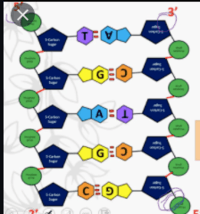
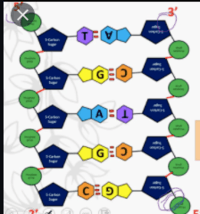
Which of the following DNA nucleotides are paired with the correct corresponding DNA nucleotide? (mark all that apply)
Adenine with Thymine
Guanine with Cytosine
Thymine with Cytosine
Adenine with Uracil.
Uracil with Thymine
4.
MULTIPLE CHOICE QUESTION
30 sec • 5 pts
Which is the role of DNA polymerase?
Unwinds the original DNA strand
Lays down RNA primer for new nucleotide bases.
Builds new strands by bringing in new nucleotide bases.
Remove Okazaki fragments for new nucleotides.
5.
MULTIPLE CHOICE QUESTION
1 min • 5 pts

Nitrogenous bases are joined by which type of bond?
6.
MULTIPLE CHOICE QUESTION
30 sec • 5 pts
Why does DNA replicate?
7.
MULTIPLE CHOICE QUESTION
2 mins • 5 pts
The process of DNA replication is called semi conservative because it results in
Access all questions and much more by creating a free account
Create resources
Host any resource
Get auto-graded reports

Continue with Google

Continue with Email

Continue with Classlink

Continue with Clever
or continue with

Microsoft
%20(1).png)
Apple

Others
Already have an account?
Similar Resources on Wayground

14 questions
Contagion

Quiz
•
7th - 11th Grade
12 questions
Cellular Energy
Quiz
•
9th - 12th Grade
20 questions
Evolution Post-Test
Quiz
•
9th - 10th Grade
15 questions
Evolution: Origin of Life
Quiz
•
9th Grade
12 questions
Prefix/Suffix Biomolecules
Quiz
•
9th - 10th Grade
15 questions
Gene Regulation Review
Quiz
•
9th - 12th Grade
20 questions
Vocabulary Quiz Immune System
Quiz
•
9th - 12th Grade
20 questions
AQA B3 Keyword Revision
Quiz
•
8th - 10th Grade
Popular Resources on Wayground
15 questions
Fractions on a Number Line
Quiz
•
3rd Grade
10 questions
Probability Practice
Quiz
•
4th Grade
15 questions
Probability on Number LIne
Quiz
•
4th Grade
20 questions
Equivalent Fractions
Quiz
•
3rd Grade
25 questions
Multiplication Facts
Quiz
•
5th Grade
22 questions
fractions
Quiz
•
3rd Grade
6 questions
Appropriate Chromebook Usage

Lesson
•
7th Grade
10 questions
Greek Bases tele and phon
Quiz
•
6th - 8th Grade
Discover more resources for Biology
22 questions
Human Body Systems Overview
Quiz
•
9th Grade
25 questions
photosynthesis and cellular respiration
Quiz
•
9th Grade
18 questions
Enzymes and Their Functions Quiz
Quiz
•
9th Grade
20 questions
Food Chains and Food Webs
Quiz
•
7th - 12th Grade
30 questions
Exploring the World of Plants
Quiz
•
9th Grade
65 questions
Review for TEST 1
Quiz
•
9th - 10th Grade
10 questions
Exploring Food Webs and Energy Pyramids

Interactive video
•
6th - 10th Grade
20 questions
Meiosis and Sexual Reproduction
Quiz
•
9th Grade