
Meiosis
Authored by Natasha Hawkins
Biology
9th - 12th Grade
Used 4+ times


AI Actions
Add similar questions
Adjust reading levels
Convert to real-world scenario
Translate activity
More...
Content View
Student View
20 questions
Show all answers
1.
MULTIPLE CHOICE QUESTION
1 min • 1 pt

Unlike mitosis, meiosis results in the formation of
one haploid gamete
three diploid gametes
four diploid gametes
four haploid gametes
Answer explanation

2.
MULTIPLE CHOICE QUESTION
1 min • 1 pt

Homologous chromosomes pair up and crossing over occurs during....
Prophase I
Prophase II
Metaphase I
Metaphase II
Answer explanation
To cross over there has to be homologous chromosomes to swap information. Crossing over therefore has to happen during prophase I, as by prophase II the homologous chromosomes have been separated into two new daughter cells.
3.
MULTIPLE CHOICE QUESTION
1 min • 1 pt

This is a period of growth when DNA is duplicated and the cell prepares for division.
cytokinesis
Interphase
Meiosis I
Meiosis II
Answer explanation
Remember, interphase always comes before cell division.
4.
MULTIPLE CHOICE QUESTION
1 min • 1 pt

A giraffe has a diploid (2n) chromosome count of 62. How many chromosomes will it have in each cell after each type of cell division?
Mitosis: 62
Meiosis: 31
Mitosis: 62
Meiosis 124
Mitosis: 31
Meiosis: 62
Mitosis: 62
Meiosis: 62
Answer explanation
Mitosis results in diploid cells that are identical to each other and have the same number of chromosomes. Meiosis results in haploid cells that have HALF the original number of chromosomes. So, if the parent cell has 62 chromosomes, after mitosis there will be 62 chromosomes, but after meiosis there will be 31.
5.
MULTIPLE CHOICE QUESTION
1 min • 1 pt
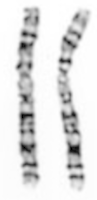
The matching pair of chromosomes shown in the diagram, one inherited from mom and one inherited from dad are called......
sister chromatids
centromeres
homologous chromosomes
autosomes
Answer explanation
Homo = similar or the same. They are homologous because they have the same genes, just possibly different variations of those genes (blue eyes/brown eyes, straight hair/curly hair).
6.
MULTIPLE CHOICE QUESTION
1 min • 1 pt
The type of reproduction in which the genetic material from two different cells combine
7.
MULTIPLE CHOICE QUESTION
1 min • 1 pt
How many daughter cells are produced from meiosis ?

Access all questions and much more by creating a free account
Create resources
Host any resource
Get auto-graded reports

Continue with Google

Continue with Email

Continue with Classlink

Continue with Clever
or continue with

Microsoft
%20(1).png)
Apple

Others
Already have an account?
Similar Resources on Wayground

15 questions
Transport across membranes

Quiz
•
12th Grade
15 questions
Chapter 4 Chemical Composition of the Cell
Quiz
•
10th Grade
20 questions
Repaso general IB1
Quiz
•
12th Grade
20 questions
Intro to Genetics Vocab Quiz
Quiz
•
9th Grade
16 questions
Digestion and Nutrition
Quiz
•
9th Grade
20 questions
FOR MARKS - Cardiovascular Terms
Quiz
•
11th - 12th Grade
15 questions
AUTOEVALUACIÓN
Quiz
•
8th - 9th Grade
20 questions
Storyline #1 Assessment
Quiz
•
9th Grade
Popular Resources on Wayground
7 questions
History of Valentine's Day

Interactive video
•
4th Grade
15 questions
Fractions on a Number Line
Quiz
•
3rd Grade
20 questions
Equivalent Fractions
Quiz
•
3rd Grade
25 questions
Multiplication Facts
Quiz
•
5th Grade
22 questions
fractions
Quiz
•
3rd Grade
15 questions
Valentine's Day Trivia
Quiz
•
3rd Grade
20 questions
Main Idea and Details
Quiz
•
5th Grade
20 questions
Context Clues
Quiz
•
6th Grade
Discover more resources for Biology
22 questions
Human Body Systems Overview
Quiz
•
9th Grade
25 questions
photosynthesis and cellular respiration
Quiz
•
9th Grade
15 questions
African American Impact in the 1980s
Quiz
•
9th Grade
20 questions
Symbiotic Relationships
Quiz
•
9th Grade
20 questions
Food Chains and Food Webs
Quiz
•
7th - 12th Grade
10 questions
Exploring Food Webs and Energy Pyramids
Interactive video
•
6th - 10th Grade
20 questions
Cladogram Practice
Quiz
•
10th Grade
20 questions
CFA #2 Unit 3 Human Body Systems (21.2 & 21.3)
Quiz
•
9th - 12th Grade