
Unit 4 & 5: Net Force, Force & Motion, Earth Science
Authored by Arlene Montano
Science
6th Grade
Used 2+ times


AI Actions
Add similar questions
Adjust reading levels
Convert to real-world scenario
Translate activity
More...
Content View
Student View
56 questions
Show all answers
1.
MULTIPLE CHOICE QUESTION
30 sec • 1 pt

If these teams are pulling with the same amount of force what will happen?
2.
MULTIPLE CHOICE QUESTION
30 sec • 1 pt

Angela blows air into a balloon and holds the end of it closed with her fingers. When she lets go of the end of the balloon, Angela observes that the release of the air propels the balloon. The propelling of the balloon from the release of the air is an example of which of Newton’s laws?
3.
MULTIPLE CHOICE QUESTION
1 min • 1 pt
Newton's third law states that any action will have a(n) _______ and ______ reaction
4.
MULTIPLE CHOICE QUESTION
30 sec • 1 pt
When a bird flies, its wings push air downward. As a result the air pushes back upward on the bird. Which law of motion most applies to the way the wings of a bird beat?
5.
MULTIPLE CHOICE QUESTION
1 min • 12 pts
__________ is stored energy.
6.
MULTIPLE CHOICE QUESTION
1 min • 1 pt
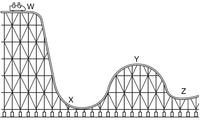
The Law of Conservation of Energy states:
7.
MULTIPLE CHOICE QUESTION
1 min • 1 pt
Energy of motion is which type of energy?


Access all questions and much more by creating a free account
Create resources
Host any resource
Get auto-graded reports

Continue with Google

Continue with Email

Continue with Classlink

Continue with Clever
or continue with

Microsoft
%20(1).png)
Apple

Others
Already have an account?
Similar Resources on Wayground

55 questions
Introduction to Science

Quiz
•
6th Grade
53 questions
Science Post-Test Review
Quiz
•
6th Grade
55 questions
Big Bang Theory, Heliocentric and Geocentric Models
Quiz
•
6th Grade
52 questions
AQA GCSE PHYSICS - ENERGY
Quiz
•
KG - 12th Grade
51 questions
Meteorology
Quiz
•
6th Grade
60 questions
Weather
Quiz
•
6th - 9th Grade
55 questions
Core Knowledge Science Review
Quiz
•
6th Grade
60 questions
Earth's Changing Climate Review
Quiz
•
6th Grade
Popular Resources on Wayground
15 questions
Fractions on a Number Line
Quiz
•
3rd Grade
10 questions
Probability Practice
Quiz
•
4th Grade
15 questions
Probability on Number LIne
Quiz
•
4th Grade
20 questions
Equivalent Fractions
Quiz
•
3rd Grade
25 questions
Multiplication Facts
Quiz
•
5th Grade
22 questions
fractions
Quiz
•
3rd Grade
6 questions
Appropriate Chromebook Usage

Lesson
•
7th Grade
10 questions
Greek Bases tele and phon
Quiz
•
6th - 8th Grade
Discover more resources for Science
20 questions
Rocks and The Rock Cycle
Quiz
•
6th Grade
10 questions
Exploring the Rock Cycle

Interactive video
•
6th - 8th Grade
8 questions
Newton's Second Law
Lesson
•
6th - 8th Grade
20 questions
Thermal Energy - Heat Transfer
Quiz
•
6th Grade
10 questions
Exploring the Rock Cycle: Types and Formation
Interactive video
•
6th - 8th Grade
25 questions
Evolution and Natural Selection Review
Quiz
•
6th - 8th Grade
22 questions
Layers of the Atmosphere
Quiz
•
6th Grade
15 questions
Punnett Squares
Quiz
•
6th Grade