
DOL - Friday November 1
5th Grade
•5 Qs

Similar activities
Properties of Matter
4th - 6th Grade
•10 Qs
Revision Worksheet - Nutrients
5th Grade
•10 Qs
Changing State- Solid, Liquid, Gas
4th - 5th Grade
•10 Qs
Pollination & Fertilisation
1st - 9th Grade
•10 Qs
KSSM_FORM 5_CHAPTER 9_SUBCHAPTER 9.2
1st - 12th Grade
•8 Qs
Properties of Materials
4th - 6th Grade
•10 Qs
Earth Systems #1
5th Grade
•10 Qs
Types of condensation
5th Grade
•10 Qs
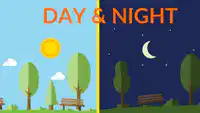
DOL - Friday November 1

Quiz
•
Science
•
5th Grade
•
Practice Problem
•
Hard
Standards-aligned

Genesis Lara
FREE Resource

Enhance your content in a minute
5 questions
Show all answers
1.
MULTIPLE CHOICE QUESTION
30 sec • 1 pt
What happens as Earth rotates on its axis over a 24-hour period?
The moon orbit the Earth
Earth completes one full orbit around the Sun
Both sides of Earth experience daylight all the time
Day and night occur as Earth rotates
Tags
NGSS.MS-ESS2-6
2.
OPEN ENDED QUESTION
3 mins • 1 pt
If Earth took 48 hours instead of 24 hours to complete one rotation on its axis, what would be the effect on the day-night cycle? Explain.
Evaluate responses using AI:
OFF
Tags
NGSS.MS-ESS1-1
3.
DRAG AND DROP QUESTION
1 min • 1 pt
A model of Earth’s rotation uses a flashlight and a globe to show the day-night cycle. What does keeping the flashlight fixed in one place represent?
Keeping the flash light in place represents (a) .
Tags
NGSS.MS-ESS1-1
4.
MULTIPLE CHOICE QUESTION
30 sec • 1 pt
Why is it incorrect to say that Earth’s orbit around the Sun causes the day-night cycle?
Earth’s orbit affects only the temperature but not the day-night cycle.
The orbit around the Sun is too slow to cause daily changes.
Day and night are caused by Earth rotating on its axis, not by orbiting the Sun.
Earth’s orbit only impacts the Moon's phases, not daylight.
Tags
NGSS.MS-ESS1-1
5.
MULTIPLE CHOICE QUESTION
30 sec • 1 pt

Based on the chart, what conclusion can you make about how Earth’s tilt affects the amount of daylight a location receives throughout the year?
Daylight hours remain constant, showing that Earth’s tilt does not affect daylight.
Daylight hours increase in June and decrease in December, indicating Earth’s tilt causes longer daylight in summer and shorter daylight in winter.
Daylight hours are longer in December and shorter in June, proving Earth’s rotation changes throughout the year.
The daylight hours only change slightly, suggesting that Earth’s tilt does not impact the seasons.
Tags
NGSS.MS-ESS1-1
Access all questions and much more by creating a free account
Create resources
Host any resource
Get auto-graded reports

Continue with Google

Continue with Email

Continue with Classlink

Continue with Clever
or continue with

Microsoft
%20(1).png)
Apple

Others
Already have an account?
Similar Resources on Wayground
10 questions
SC.5.N.1.1 Nature of Science Review
Quiz
•
5th Grade
10 questions
CPR
Quiz
•
1st - 7th Grade
10 questions
Landforms vocabulary
Quiz
•
4th - 5th Grade
10 questions
Black Inventors
Quiz
•
3rd Grade - University
10 questions
STRUCTURE OF LIFE
Quiz
•
5th Grade
10 questions
Science Fifth Grade
Quiz
•
5th Grade
10 questions
2. A Snake Charmer's story
Quiz
•
5th Grade
10 questions
Forms & Uses of Energy
Quiz
•
5th Grade
Popular Resources on Wayground
15 questions
Fractions on a Number Line
Quiz
•
3rd Grade
20 questions
Equivalent Fractions
Quiz
•
3rd Grade
25 questions
Multiplication Facts
Quiz
•
5th Grade
22 questions
fractions
Quiz
•
3rd Grade
20 questions
Main Idea and Details
Quiz
•
5th Grade
20 questions
Context Clues
Quiz
•
6th Grade
15 questions
Equivalent Fractions
Quiz
•
4th Grade
20 questions
Figurative Language Review
Quiz
•
6th Grade
Discover more resources for Science
20 questions
The Water Cycle
Quiz
•
5th Grade
20 questions
Weathering, Erosion, Deposition
Quiz
•
5th Grade
20 questions
Food Chains and Food Webs Review
Quiz
•
5th Grade
21 questions
Solar System Review
Quiz
•
5th Grade
20 questions
Food Webs
Quiz
•
5th Grade
18 questions
Acquired Trait and Inherited Trait
Quiz
•
5th Grade
20 questions
Food Chains & Food Webs
Quiz
•
5th - 7th Grade
19 questions
Mixtures and Solutions
Quiz
•
5th Grade