
Plate Tectonics
Authored by Erin Gaines
Science
6th Grade
NGSS covered
Used 1+ times


AI Actions
Add similar questions
Adjust reading levels
Convert to real-world scenario
Translate activity
More...
Content View
Student View
25 questions
Show all answers
1.
MULTIPLE SELECT QUESTION
45 sec • 1 pt
convergent boundary

where two plates are moving toward each other


2.
MULTIPLE SELECT QUESTION
45 sec • 1 pt
Divergent boundary
where two plates are moving away from each other
may result in seafloor spreading

where two plates slide past each other
3.
MULTIPLE CHOICE QUESTION
45 sec • 1 pt
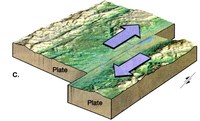
What type of event will occur at this boundary?
Tags
NGSS.MS-ESS2-3
NGSS.MS-ESS3-2
4.
MULTIPLE CHOICE QUESTION
45 sec • 1 pt
The thin and solid outermost layer of the Earth.
outer core
inner core
mantle
crust
5.
MULTIPLE CHOICE QUESTION
45 sec • 1 pt

What is the source of energy that drives plate movement?
the subducton of the sea floor
the different densities of the oceanic and crustal plates
convection currents in the asthenosphere
the friction force between the plates that move past each other
Tags
NGSS.MS-ESS2-3
6.
MULTIPLE CHOICE QUESTION
45 sec • 1 pt

What kind of boundary is shown here?
divergent
transform
convergent
Tags
NGSS.MS-ESS2-3
7.
MULTIPLE CHOICE QUESTION
45 sec • 5 pts
Tectonic plates can be made of continental crust or oceanic crust, or a combination of the two. Besides their locations, how else are these two kinds of crust different?
Continental crust is thinner than oceanic crust.
Continental crust is thicker than oceanic crust.
Tectonic plates made of continental crust are larger than plates made of oceanic crust.
Tectonic plates made of continental crust are smaller than plates made of oceanic crust.


Access all questions and much more by creating a free account
Create resources
Host any resource
Get auto-graded reports

Continue with Google

Continue with Email

Continue with Classlink

Continue with Clever
or continue with

Microsoft
%20(1).png)
Apple

Others
Already have an account?


