
AP Chemistry Q3 Extra Credit
Authored by Suzanne Maloney
Chemistry
11th Grade
Used 1+ times


AI Actions
Add similar questions
Adjust reading levels
Convert to real-world scenario
Translate activity
More...
Content View
Student View
90 questions
Show all answers
1.
MULTIPLE CHOICE QUESTION
1 min • 1 pt

Intermolecular forces for: CO2
Dispersion Force
Dipole dipole
Hydrogen bonding
2.
MULTIPLE CHOICE QUESTION
30 sec • 1 pt
What explains the very high melting and boiling point of water
3.
MULTIPLE CHOICE QUESTION
1 min • 1 pt
All molecules have London forces between them, but dipole-dipole and hydrogen bonding are so much stronger that when they are present we can ignore London forces. Which of these has ONLY London forces?
4.
MULTIPLE CHOICE QUESTION
2 mins • 1 pt
Which substance would have the weakest intermolecular forces of attraction?
CH4
NaCl
H2O
MgF2
5.
MULTIPLE CHOICE QUESTION
45 sec • 1 pt
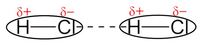
Which type of IMF is pictured above?
Dipole-Dipole Interaction
Ion-Dipole Interaction
Hydrogen Bonds
Covalent Bond
Ionic Bond
6.
MULTIPLE CHOICE QUESTION
45 sec • 1 pt

Which molecule will have hydrogen bonds with other molecules in the sample?
a) CO2
b) HCN
c) C2H2
none of the above
7.
MULTIPLE CHOICE QUESTION
45 sec • 1 pt
Crystalline solids _____
have their particles arranged randomly
have highly ordered structures
are usually very soft
exist only at high temperatures
Access all questions and much more by creating a free account
Create resources
Host any resource
Get auto-graded reports

Continue with Google

Continue with Email

Continue with Classlink

Continue with Clever
or continue with

Microsoft
%20(1).png)
Apple

Others
Already have an account?



