
Selective Breeding Vs Natural Selection
7th Grade
•21 Qs

Similar activities
Plants for Food and Fibre
6th - 8th Grade
•18 Qs
Topic 7, Lesson 3 - Rocks
6th - 8th Grade
•23 Qs
Adaptation and Natural Selection
7th Grade
•20 Qs
Revisões_ciclo_das_rochas
7th Grade
•19 Qs
Renewable and non-renewable resources
6th - 7th Grade
•20 Qs
PTS_IPA7_GANJIL
7th Grade
•20 Qs
ESPACIOS NATURALES
5th - 8th Grade
•16 Qs
Structures Mid-Term Grade 7
7th Grade
•19 Qs

Selective Breeding Vs Natural Selection

Quiz
•
Science
•
7th Grade
•
Medium
+4
Standards-aligned

Wesley Webster
Used 2+ times
FREE Resource

Enhance your content in a minute
21 questions
Show all answers
1.
MULTIPLE CHOICE QUESTION
30 sec • 1 pt
What is natural selection?
a living individual that can carry out life processes
Process by which an organism that better adapts to their environment survive and reproduce
Process by which a community better adapts to their environment to give traits to one another within their generation.
the time between when an organism is born and when they reproduce
Tags
NGSS.MS-LS4-4
2.
MULTIPLE CHOICE QUESTION
15 mins • 1 pt
Which of the following is an example of selective breeding?
A. Letting dogs choose their own mate.
B. Crossing a Labrador with a Poodle to create a Labradoodle.
C. Creating larger ears of corn.
Both B and C
Tags
NGSS.MS-LS4-4
NGSS.MS-LS4-5
3.
MULTIPLE CHOICE QUESTION
30 sec • 1 pt

What is most likely to happen to moth populations in the picture shown?
Light moths--hunted easily, dark moths--population increase
Dark moths--hunted easily, dark moths--population increase
Light moths--hunted easily, light moths--population increase
Lights moths will change their color to match dark moths.
Tags
NGSS.MS-LS2-1
NGSS.MS-LS2-4
NGSS.MS-LS4-4
4.
MULTIPLE CHOICE QUESTION
30 sec • 1 pt
What is the advantage of having different shaped beaks?
Tags
NGSS.MS-LS2-1
NGSS.MS-LS4-2
NGSS.MS-LS4-4
5.
MULTIPLE CHOICE QUESTION
30 sec • 1 pt
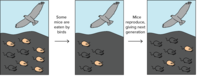
Why is the mouse population changing over time?
Tags
NGSS.MS-LS1-4
NGSS.MS-LS2-4
NGSS.MS-LS4-4
6.
MULTIPLE CHOICE QUESTION
30 sec • 1 pt
Selective breeding
organisms better adapted to their environment tend to survive and produce more offspring
process used by humans to develop new organisms with desirable characteristics
Tags
NGSS.MS-LS4-4
7.
MULTIPLE CHOICE QUESTION
30 sec • 1 pt

Which is an example of selective breeding?
A giraffe's long neck.
Clipping a dog's claws so it's not too long.
Training a horse to run faster.
Cross breeding a labrador retriever with a poodle .
Tags
NGSS.MS-LS4-4
NGSS.MS-LS4-5


Create a free account and access millions of resources
Create resources
Host any resource
Get auto-graded reports

Continue with Google

Continue with Email

Continue with Classlink

Continue with Clever
or continue with

Microsoft
%20(1).png)
Apple

Others
Already have an account?
Similar Resources on Wayground
18 questions
7x/Sc4 - Atoms, Elements, Compounds and Mixtures
Quiz
•
7th - 8th Grade
20 questions
Ecología y Medio Ambiente
Quiz
•
3rd Grade - University
20 questions
La Terra a l'Univers
Quiz
•
7th Grade
20 questions
Energy Sources
Quiz
•
7th - 10th Grade
26 questions
FL Nature of Science Grade 5-8 Vocabulary
Quiz
•
5th - 8th Grade
18 questions
Human Impact on the Environment
Quiz
•
6th - 8th Grade
18 questions
Population Resources
Quiz
•
7th Grade
20 questions
GRADE 6 FE 2025
Quiz
•
6th Grade - University
Popular Resources on Wayground
10 questions
Honoring the Significance of Veterans Day

Interactive video
•
6th - 10th Grade
9 questions
FOREST Community of Caring

Lesson
•
1st - 5th Grade
10 questions
Exploring Veterans Day: Facts and Celebrations for Kids
Interactive video
•
6th - 10th Grade
19 questions
Veterans Day
Quiz
•
5th Grade
14 questions
General Technology Use Quiz
Quiz
•
8th Grade
25 questions
Multiplication Facts
Quiz
•
5th Grade
15 questions
Circuits, Light Energy, and Forces
Quiz
•
5th Grade
19 questions
Thanksgiving Trivia
Quiz
•
6th Grade
Discover more resources for Science
20 questions
Photosynthesis and Cellular Respiration
Quiz
•
7th Grade
10 questions
Exploring Newton's Laws of Motion
Interactive video
•
6th - 10th Grade
20 questions
Balanced and Unbalanced Forces
Quiz
•
6th - 8th Grade
20 questions
genetics, punnett squares, heredity
Quiz
•
7th Grade
22 questions
Plate Tectonics
Lesson
•
6th - 8th Grade
9 questions
Conduction, Convection, and Radiation
Lesson
•
6th - 8th Grade
15 questions
Calculating, speed, distance and Time
Quiz
•
7th Grade
13 questions
Thermal Equilibrium (7.8B)
Quiz
•
7th Grade