
Survivorship curves and carrying capacity and limiting factors
Authored by Patrick Ondondo
Biology
9th - 12th Grade
NGSS covered
Used 59+ times


AI Actions
Add similar questions
Adjust reading levels
Convert to real-world scenario
Translate activity
More...
Content View
Student View
25 questions
Show all answers
1.
MULTIPLE CHOICE QUESTION
30 sec • 5 pts

What is a population ?
Disturbance has removed vegetation but left soil intact.
The natural birth, growth and development of ecosystem.
All organisms of a species that live in the same area.
A community of interacting organisms and their environment.
Tags
NGSS.HS-LS2-2
2.
MULTIPLE CHOICE QUESTION
1 min • 1 pt
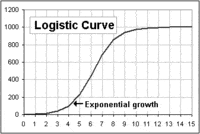
What is the carrying capacity of the following graph?
Tags
NGSS.MS-LS2-4
NGSS.MS-LS2-1
3.
MULTIPLE CHOICE QUESTION
30 sec • 1 pt

According to the graph, what is the maximum number of deer that this ecosystem can support?
100
90
80
70
Tags
NGSS.HS-LS2-1
4.
MULTIPLE CHOICE QUESTION
30 sec • 3 pts
Which would be least likely to be affected by a density-dependent limiting factor?
a small, scattered population
a population with a high birthrate
a large, dense population
a population with a high immigration rate
Tags
NGSS.MS-LS2-4
5.
MULTIPLE CHOICE QUESTION
30 sec • 1 pt

What type of growth is shown on this graph?
6.
MULTIPLE CHOICE QUESTION
30 sec • 1 pt

Type 3 graphs show
Some death rates
Death rates through out
Death rates at older ages
High death rates at a young age
Tags
NGSS.HS-LS4-5
7.
MULTIPLE CHOICE QUESTION
30 sec • 1 pt

Secondary succession is most likely to occur


Access all questions and much more by creating a free account
Create resources
Host any resource
Get auto-graded reports

Continue with Google

Continue with Email

Continue with Microsoft
or continue with

%20(1).png)
Apple

Others
By signing up, you agree to our Terms of Service & Privacy Policy
Already have an account?


