
Unit 5: Big Bang Theory Review: Exploring Star Spectra
Authored by Alison Klein
Science
9th Grade
NGSS covered
Used 2+ times


AI Actions
Add similar questions
Adjust reading levels
Convert to real-world scenario
Translate activity
More...
Content View
Student View
10 questions
Show all answers
1.
MULTIPLE SELECT QUESTION
30 sec • 1 pt
The Big Bang theory provides an explanation for how the universe began. Which statement best describes how the Universe began? Select all statements that apply.
The Universe is 14 Billion years old.
The Universe formed in an explosion of energy and matter.
All of the energy and matter were contained in a tiny location called the primordial atom.
The Universe never began, it has always existed.
Tags
NGSS.HS-ESS1-2
2.
MULTIPLE CHOICE QUESTION
30 sec • 1 pt

Our universe is made of galaxies of stars. Edwin Hubble observed that most galaxies are moving away from us. Which galaxies are observed to be moving away the fastest? This relationship is called Hubble's Law
The close galaxies move away the fastest.
The far galaxies move away the fastest.
All galaxies move at the same rate.
None of the galaxies are moving.
Tags
NGSS.HS-ESS1-2
NGSS.HS-ESS1-4
3.
MULTIPLE SELECT QUESTION
30 sec • 1 pt
Which of the following would give a continuous spectrum? (check all that apply)
hydrogen lamp
the sun
neon lights
white light bulbs
Tags
NGSS.HS-PS4-3
NGSS.HS-PS4-4
4.
MULTIPLE CHOICE QUESTION
3 mins • 1 pt

What is the light that you can see called?
observatory light
ultraviolet light
visible light
infrared light
Tags
NGSS.HS-PS4-3
NGSS.HS-PS4-4
5.
MULTIPLE CHOICE QUESTION
30 sec • 1 pt
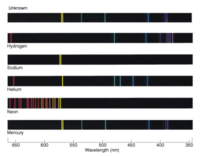
The unknown emissions spectra belongs to the element
Hydrogen
Mercury
Neon
Sodium
Tags
NGSS.HS-PS1-1
NGSS.HS-PS4-3
6.
MULTIPLE CHOICE QUESTION
30 sec • 1 pt

The unknown emissions spectra belongs to the element
Hydrogen
Mercury
Neon
Sodium
Tags
NGSS.HS-PS1-1
NGSS.HS-PS4-1
7.
MULTIPLE CHOICE QUESTION
30 sec • 1 pt

The absorption spectrum of the Sun matched the emission spectra of flame tests on Earth.
What did scientists think this meant?
The Sun is made of different elements than those found on Earth.
The Sun is made of Energy.
The Sun is made of the same elements as those found on Earth
Scientists do not know what the Sun is made of.
Tags
NGSS.HS-PS1-1
NGSS.HS-ESS1-3


Access all questions and much more by creating a free account
Create resources
Host any resource
Get auto-graded reports

Continue with Google

Continue with Email

Continue with Classlink

Continue with Clever
or continue with

Microsoft
%20(1).png)
Apple

Others
Already have an account?


