
DNA Structure and Replication
Authored by Ashley Osborne
Biology
9th Grade
NGSS covered
Used 20+ times


AI Actions
Add similar questions
Adjust reading levels
Convert to real-world scenario
Translate activity
More...
Content View
Student View
14 questions
Show all answers
1.
MULTIPLE CHOICE QUESTION
30 sec • 1 pt
What is the basic structure of DNA?
single strand
triple helix
square shape
double helix
2.
MULTIPLE CHOICE QUESTION
30 sec • 1 pt
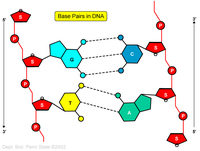
If a DNA strand has 35% A, what percent T would be present?
25%
35%
15%
20%
3.
MULTIPLE CHOICE QUESTION
30 sec • 1 pt
What is the base pair rules?
A goes with T, C goes with G
A goes with G, C goes with T
A goes with C, G goes with T
A goes with U, C goes with G
4.
MULTIPLE CHOICE QUESTION
30 sec • 1 pt
Which nucleotide pairs with adenine in DNA?
cytosine
guanine
thymine
uracil
5.
MULTIPLE CHOICE QUESTION
30 sec • 1 pt
What is the process of DNA replication?
DNA replication is the process by which a double-stranded RNA molecule is copied to produce two identical RNA molecules.
DNA replication is the process by which a double-stranded DNA molecule is copied to produce two identical DNA molecules.
DNA replication is the process by which RNA is copied to produce two identical RNA molecules.
DNA replication is the process by which a single-stranded DNA molecule is copied to produce two identical DNA molecules.
6.
MULTIPLE CHOICE QUESTION
30 sec • 1 pt
What is the role of DNA polymerase in replication?
DNA polymerase helps in the formation of RNA during replication.
DNA polymerase unzips the DNA strands
DNA polymerase breaks down the existing DNA strands during replication.
DNA polymerase adds in the new bases following the base pair rules
7.
MULTIPLE CHOICE QUESTION
30 sec • 1 pt
What is meant by semi-conservative replication?
Each new DNA molecule consists of one original strand and one strand from another DNA molecule.
Each new DNA molecule consists of two newly synthesized strands.
Each new DNA molecule consists of two original strands.
Each new DNA molecule consists of one original strand and one newly synthesized strand.
Access all questions and much more by creating a free account
Create resources
Host any resource
Get auto-graded reports

Continue with Google

Continue with Email

Continue with Microsoft
or continue with

%20(1).png)
Apple

Others
Already have an account?

