
Chemical Reactions and Enzymes

Chemical Reactions and Enzymes

9th Grade

21 Qs

quiz-placeholder

Similar activities

7.1 Food Chains, Producers and Consumers

7.1 Food Chains, Producers and Consumers

9th - 11th Grade

20 Qs

Diffusion and Osmosis

Diffusion and Osmosis

9th - 10th Grade

19 Qs

DNA, Replication and Protein Synthesis Review

DNA, Replication and Protein Synthesis Review

9th Grade

20 Qs

Environmental Systems Final Review

Environmental Systems Final Review

9th - 12th Grade

26 Qs

Subkingdom Algae

Subkingdom Algae

9th - 10th Grade

17 Qs

Mrs. Coble's Ecology Review

Mrs. Coble's Ecology Review

9th - 12th Grade

20 Qs

Cellular Respiration

Cellular Respiration

9th - 12th Grade

20 Qs

B6 DNA

B6 DNA

8th - 11th Grade

17 Qs

Chemical Reactions and Enzymes

Chemical Reactions and Enzymes

Assessment

Quiz

Biology

9th Grade

Easy

NGSS
HS-PS1-7, HS-PS1-5, MS-PS1-2

+3

Standards-aligned

Created by

Jodi Schmidt

Used 1+ times

FREE Resource

AI

Enhance your content

Add similar questions
Adjust reading levels
Convert to real-world scenario
Translate activity
More...

21 questions

Show all answers

1.

MULTIPLE CHOICE QUESTION

1 min • 1 pt

True or False
In a chemical reaction, no new atoms are created, and no atoms are destroyed. 
true
false

Tags

NGSS.HS-PS1-7

2.

MULTIPLE CHOICE QUESTION

1 min • 1 pt

Media Image
The right side of the equation below is called the
products
reactants

3.

MULTIPLE CHOICE QUESTION

1 min • 1 pt

Media Image
The left side of the equation below is called
Products
Reactants

Tags

NGSS.MS-PS1-2

4.

MULTIPLE CHOICE QUESTION

1 min • 1 pt

In a chemical reaction
The atoms of the reactants always stay together to form the products
The atoms of the reactants unbond, rearrange, and then rebond to form the products
New atoms are formed which combine to make the products
Some atoms disappear while others multiply to form the products

Tags

NGSS.HS-PS1-7

5.

MULTIPLE CHOICE QUESTION

1 min • 1 pt

The process of removing water in order to form a bond between monomers is called....
Dehydration Synthesis
Hydrolysis

6.

MULTIPLE CHOICE QUESTION

1 min • 1 pt

The process of digesting a polysaccharide into individual monosaccharides is called....
Dehydration Synthesis
Hydrolysis

7.

MULTIPLE CHOICE QUESTION

1 min • 1 pt

Media Image
The following figure is illustrating
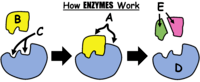
Dehydration Synthesis
Hydrolysis

Create a free account and access millions of resources

Create resources

Host any resource

Get auto-graded reports

Google

Continue with Google

Email

Continue with Email

Classlink

Continue with Classlink

Clever

Continue with Clever

or continue with

Microsoft

Microsoft

Apple

Apple

Others

Others

By signing up, you agree to our Terms of Service & Privacy Policy

Already have an account?




