
NGSS.MS-PS1-4
Authored by Wayground Content
Science
6th - 8th Grade
NGSS covered


AI Actions
Add similar questions
Adjust reading levels
Convert to real-world scenario
Translate activity
More...
Content View
Student View
20 questions
Show all answers
1.
MULTIPLE CHOICE QUESTION
1 min • 1 pt

In this experiment, the WARM red dye and the COLD blue dye was placed in the water at the same time. The warm red dye rose to the top while the cold blue dye sank to the bottom.
Tags
NGSS.MS-PS1-4
2.
MULTIPLE CHOICE QUESTION
30 sec • 1 pt
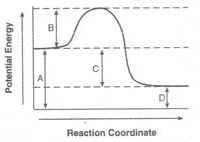
What type of reaction is this?
Tags
NGSS.MS-PS1-4
3.
MULTIPLE CHOICE QUESTION
1 min • 1 pt
What are the states of matter?
Tags
NGSS.MS-PS1-4
4.
MULTIPLE CHOICE QUESTION
30 sec • 1 pt
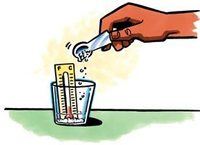
In an endothermic reaction, heat is ...
Tags
NGSS.MS-PS1-4
5.
MULTIPLE CHOICE QUESTION
30 sec • 1 pt

Steam rising from wet clothes while ironing them. This is an example of__________.
Evaporation
Condensation
Tags
NGSS.MS-PS1-4
6.
MULTIPLE CHOICE QUESTION
5 mins • 1 pt
If you have a liquid that changes to a gas, explain it's freedom of movement in both phases.
Tags
NGSS.MS-PS1-4
7.
MULTIPLE CHOICE QUESTION
30 sec • 1 pt
S8P2d A metal spoon is placed in a pot of boiling water. Why does the spoon become hot over time?
Currents of hot matter travel up the spoon from the water
Light shining on the spoon causes it to become as hot as the water
Particles in the water collide with particles in the spoon, which then strike other particles in the spoon, transferring energy
Microwaves emitted by the hot water are absorbed by the spoon and transformed into thermal energy
Tags
NGSS.MS-PS1-4
Access all questions and much more by creating a free account
Create resources
Host any resource
Get auto-graded reports

Continue with Google

Continue with Email

Continue with Classlink

Continue with Clever
or continue with

Microsoft
%20(1).png)
Apple

Others
Already have an account?
Similar Resources on Wayground

16 questions
Development of The Cell Theory.

Quiz
•
8th Grade
20 questions
What is electricity?
Quiz
•
6th Grade
20 questions
Common Assessment #2 Review
Quiz
•
6th Grade
18 questions
Repeat for Test
Quiz
•
8th Grade
15 questions
TLE 8 - Cleaning and Sanitizing Kitchen Tools
Quiz
•
7th - 8th Grade
16 questions
Ecosystems Review
Quiz
•
6th Grade
15 questions
Comp Sci 3 FSA Prep Day 6
Quiz
•
8th Grade
18 questions
The hydrosphere and the geosphere
Quiz
•
6th Grade
Popular Resources on Wayground
7 questions
History of Valentine's Day

Interactive video
•
4th Grade
15 questions
Fractions on a Number Line
Quiz
•
3rd Grade
20 questions
Equivalent Fractions
Quiz
•
3rd Grade
25 questions
Multiplication Facts
Quiz
•
5th Grade
22 questions
fractions
Quiz
•
3rd Grade
15 questions
Valentine's Day Trivia
Quiz
•
3rd Grade
20 questions
Main Idea and Details
Quiz
•
5th Grade
20 questions
Context Clues
Quiz
•
6th Grade
Discover more resources for Science
11 questions
Valentines Day
Quiz
•
6th - 8th Grade
25 questions
Valentine's Day Trivia
Quiz
•
8th Grade
20 questions
Cell Organelles and Functions
Quiz
•
6th - 8th Grade
20 questions
Rocks and The Rock Cycle
Quiz
•
6th Grade
8 questions
Newton's Second Law

Lesson
•
6th - 8th Grade
20 questions
Thermal Energy - Heat Transfer
Quiz
•
6th Grade
10 questions
Exploring the Rock Cycle: Types and Formation
Interactive video
•
6th - 8th Grade
10 questions
Carbon Cycle
Lesson
•
6th - 8th Grade