
NGSS.MS-PS1-5
Authored by Wayground Content
Science
6th - 8th Grade
NGSS covered


AI Actions
Add similar questions
Adjust reading levels
Convert to real-world scenario
Translate activity
More...
Content View
Student View
20 questions
Show all answers
1.
MULTIPLE CHOICE QUESTION
2 mins • 12 pts
What is the Law of Conservation of mass?
Tags
NGSS.MS-PS1-5
2.
MULTIPLE CHOICE QUESTION
2 mins • 1 pt
Students react baking soda & vinegar.
Which of the following would provide the evidence that the number of atoms present before a chemical reaction is equal to the number of atoms present after the chemical reaction?
Tags
NGSS.MS-PS1-5
3.
MULTIPLE CHOICE QUESTION
30 sec • 1 pt
The Law of Conservation of Matter
tells how many atoms of an element are contained in one molecule or formula unit.
the starting materials in a chemical reaction
the new substances that are formed in a chemical reaction
A law stating that atoms are not created or destroyed during a chemical reaction.
Tags
NGSS.MS-PS1-5
4.
MULTIPLE CHOICE QUESTION
30 sec • 1 pt
The law of conservation of mass can be demonstrated by a chemical reaction. Which of the following models of a chemical reaction best represents the law of conservation of mass?


Tags
NGSS.MS-PS1-5
5.
MULTIPLE CHOICE QUESTION
30 sec • 1 pt
chemical reaction
Tags
NGSS.MS-PS1-5
6.
MULTIPLE CHOICE QUESTION
30 sec • 1 pt
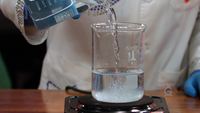
During a chemical reaction, atoms are ___________.
Tags
NGSS.MS-PS1-5
7.
MULTIPLE CHOICE QUESTION
30 sec • 1 pt
So, the Law of Conservation of Mass would tell us that the mass of all the REACTANTS must __________ the mass of all PRODUCTS in a chemical reaction.
equal
be greater than
be less than
Tags
NGSS.MS-PS1-5
Access all questions and much more by creating a free account
Create resources
Host any resource
Get auto-graded reports

Continue with Google

Continue with Email

Continue with Classlink

Continue with Clever
or continue with

Microsoft
%20(1).png)
Apple

Others
Already have an account?
Similar Resources on Wayground

18 questions
The hydrosphere and the geosphere

Quiz
•
6th Grade
16 questions
Development of The Cell Theory.
Quiz
•
8th Grade
20 questions
Common Assessment #2 Review
Quiz
•
6th Grade
18 questions
Repeat for Test
Quiz
•
8th Grade
15 questions
TLE 8 - Cleaning and Sanitizing Kitchen Tools
Quiz
•
7th - 8th Grade
16 questions
Ecosystems Review
Quiz
•
6th Grade
19 questions
Forces, Newton's Laws, Electromagnets, & the Universe
Quiz
•
8th Grade
15 questions
Comp Sci 3 FSA Prep Day 6
Quiz
•
8th Grade
Popular Resources on Wayground
7 questions
History of Valentine's Day

Interactive video
•
4th Grade
15 questions
Fractions on a Number Line
Quiz
•
3rd Grade
20 questions
Equivalent Fractions
Quiz
•
3rd Grade
25 questions
Multiplication Facts
Quiz
•
5th Grade
22 questions
fractions
Quiz
•
3rd Grade
15 questions
Valentine's Day Trivia
Quiz
•
3rd Grade
20 questions
Main Idea and Details
Quiz
•
5th Grade
20 questions
Context Clues
Quiz
•
6th Grade
Discover more resources for Science
11 questions
Valentines Day
Quiz
•
6th - 8th Grade
25 questions
Valentine's Day Trivia
Quiz
•
8th Grade
20 questions
Cell Organelles and Functions
Quiz
•
6th - 8th Grade
20 questions
Rocks and The Rock Cycle
Quiz
•
6th Grade
8 questions
Newton's Second Law

Lesson
•
6th - 8th Grade
20 questions
Thermal Energy - Heat Transfer
Quiz
•
6th Grade
10 questions
Exploring the Rock Cycle: Types and Formation
Interactive video
•
6th - 8th Grade
10 questions
Carbon Cycle
Lesson
•
6th - 8th Grade