
Science of Reading Quiz
Authored by Kate Ludington
Mathematics
4th Grade
CCSS covered
Used 1+ times


AI Actions
Add similar questions
Adjust reading levels
Convert to real-world scenario
Translate activity
More...
Content View
Student View
15 questions
Show all answers
1.
MULTIPLE CHOICE QUESTION
30 sec • 1 pt
What does the Science of Reading refer to?
A single approach to teaching reading
A body of research documenting how children develop reading and writing skills
A method for teaching mathematics
A guide for physical education
Tags
CCSS.RF.4.4A
CCSS.RF.4.4B
CCSS.RF.4.4C
CCSS.RF.5.3A
CCSS.RF.3.3A
2.
MULTIPLE CHOICE QUESTION
30 sec • 1 pt
How many years of interdisciplinary research does the Science of Reading reflect?
10+ years
20+ years
50+ years
100+ years
3.
MULTIPLE CHOICE QUESTION
30 sec • 1 pt
What does the Science of Reading feature?
Principles and practices for research-based instructional design and opportunities to learn
Methods for teaching sports
Guidelines for physical education
Techniques for cooking
4.
MULTIPLE CHOICE QUESTION
30 sec • 1 pt
Which students benefit from the Science of Reading?
Only students without disabilities
Only English Language Learners
All populations, including students at-risk or identified with disabilities
Only students in primary grades
5.
MULTIPLE CHOICE QUESTION
30 sec • 1 pt
What should the Science of Reading continually inform?
Only vocabulary instruction
Prevention and intervention efforts and daily instruction
Only comprehension strategies
Only primary grade instruction
Tags
CCSS.RF.4.4A
CCSS.RF.4.4B
CCSS.RF.4.4C
CCSS.RF.5.3A
CCSS.RF.5.4A
6.
MULTIPLE CHOICE QUESTION
30 sec • 1 pt
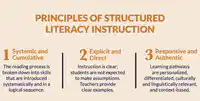
What is the second principle of structured literacy instruction?
Systemic and Cumulative
Explicit and Direct
Responsive and Authentic
Implicit and Indirect
Tags
CCSS.RF.4.4A
CCSS.RF.4.4B
CCSS.RF.4.4C
CCSS.RF.5.3A
CCSS.RF 4.3.A
7.
MULTIPLE CHOICE QUESTION
30 sec • 1 pt
What does the principle of 'Explicit and Direct' entail?
Instruction is unclear
Students are expected to make assumptions
Instruction is clear; students are not expected to make assumptions
Teachers do not provide examples
Tags
CCSS.RF.4.4A
CCSS.RF.4.4B
CCSS.RF.4.4C
CCSS.RF.3.3D
CCSS.RF.3.4A
Access all questions and much more by creating a free account
Create resources
Host any resource
Get auto-graded reports

Continue with Google

Continue with Email

Continue with Classlink

Continue with Clever
or continue with

Microsoft
%20(1).png)
Apple

Others
Already have an account?


