
- Resource Library
- Science
- Chemistry
- Balancing Chemical Equations
- Mastering The Art Of Balancing Chemical Equations
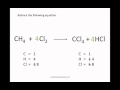
Mastering the Art of Balancing Chemical Equations

Interactive Video
•
Science
•
6th - 10th Grade
•
Practice Problem
•
Hard
Standards-aligned

Emma Peterson
FREE Resource
Standards-aligned
10 questions
Show all answers
1.
MULTIPLE CHOICE QUESTION
30 sec • 1 pt
What fundamental principle states that atoms are neither created nor destroyed in a chemical reaction?
Law of Multiple Proportions
Law of Conservation of Mass
Law of Constant Composition
Law of Definite Proportions
Tags
NGSS.MS-PS1-5
2.
MULTIPLE CHOICE QUESTION
30 sec • 1 pt
When balancing chemical equations, what can you change to balance the equation?
Coefficients
Subscripts
Atomic numbers
Chemical symbols
3.
MULTIPLE CHOICE QUESTION
30 sec • 1 pt
In the first example, what is the initial number of hydrogen atoms on the reactant side?
Five
One
Two
Four
Tags
NGSS.MS-PS1-1
4.
MULTIPLE CHOICE QUESTION
30 sec • 1 pt
What coefficient is added in front of HCl to balance the hydrogen atoms in the first example?
Two
Five
Three
Four
Tags
NGSS.MS-PS1-5
5.
MULTIPLE CHOICE QUESTION
30 sec • 1 pt
After balancing hydrogen in the first example, how many chlorine atoms are on the product side?
Six
Four
Eight
Two
Tags
NGSS.MS-PS1-5
6.
MULTIPLE CHOICE QUESTION
30 sec • 1 pt
Why is it important to ensure coefficients are in their lowest ratio?
To balance the charges
To ensure the equation is correct
To make the equation look simpler
To follow standard conventions
Tags
NGSS.MS-PS1-5
7.
MULTIPLE CHOICE QUESTION
30 sec • 1 pt
In the second example, how many oxygen atoms are initially on the reactant side?
Twelve
Eleven
Ten
Thirteen
Tags
NGSS.MS-PS1-1
Access all questions and much more by creating a free account
Create resources
Host any resource
Get auto-graded reports

Continue with Google

Continue with Email

Continue with Classlink

Continue with Clever
or continue with

Microsoft
%20(1).png)
Apple

Others
Already have an account?


