
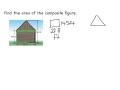
Exploring the Area of Composite Figures

Interactive Video
•
Mathematics
•
6th - 10th Grade
•
Practice Problem
•
Medium
+1
Standards-aligned

Emma Peterson
Used 2+ times
FREE Resource
Standards-aligned
10 questions
Show all answers
1.
MULTIPLE CHOICE QUESTION
30 sec • 1 pt
What is an irregular figure?
A figure that is always a rectangle
A figure with an unfamiliar shape
A figure that cannot be divided
A figure with a familiar shape
Tags
CCSS.1.G.A.2
2.
MULTIPLE CHOICE QUESTION
30 sec • 1 pt
How can you find the area of a composite figure?
By adding the areas of its parts
By multiplying its dimensions
By using the Pythagorean theorem
By measuring its perimeter
3.
MULTIPLE CHOICE QUESTION
30 sec • 1 pt
What is the purpose of dividing composite figures into familiar shapes?
To make them easier to draw
To simplify the calculation of their area
To increase their size
To change their geometric properties
Tags
CCSS.3.MD.C.7D
4.
MULTIPLE CHOICE QUESTION
30 sec • 1 pt
What shapes were used to calculate the area of the first composite figure?
Triangles and rectangles
Circles and squares
Rectangles only
Trapezoids and circles
5.
MULTIPLE CHOICE QUESTION
30 sec • 1 pt
What is the area of the first composite figure?
44 cm²
157 mm²
27 cm²
100 mm²
Tags
CCSS.6.G.A.1
6.
MULTIPLE CHOICE QUESTION
30 sec • 1 pt
How do you calculate the area of a triangle?
Length times width
Base plus height
Base times height divided by two
Base times height
Tags
CCSS.6.G.A.1
7.
MULTIPLE CHOICE QUESTION
30 sec • 1 pt
How is the radius of the circle related to the height of the triangle in the second composite figure?
The height is double the radius
They are equal
The radius is half of the height
There is no relation
Access all questions and much more by creating a free account
Create resources
Host any resource
Get auto-graded reports

Continue with Google

Continue with Email

Continue with Classlink

Continue with Clever
or continue with

Microsoft
%20(1).png)
Apple

Others
Already have an account?


