
- Resource Library
- Math
- Multiplication
- Properties Of Multiplication
- Exploring Associative And Distributive Properties Of Multiplication
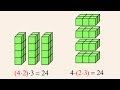
Exploring Associative and Distributive Properties of Multiplication

Interactive Video
•
Mathematics
•
6th - 10th Grade
•
Practice Problem
•
Hard
+3
Standards-aligned

Olivia Brooks
FREE Resource
Standards-aligned
10 questions
Show all answers
1.
MULTIPLE CHOICE QUESTION
30 sec • 1 pt
Is the order of numbers important in addition and multiplication?
Only in addition.
Yes, it changes the result.
No, it doesn't affect the result.
Only in multiplication.
Tags
CCSS.1.OA.B.3
2.
MULTIPLE CHOICE QUESTION
30 sec • 1 pt
Can numbers in addition be grouped in any way without changing the result?
Only with odd numbers.
Yes, always.
No, never.
Only with even numbers.
Tags
CCSS.1.OA.B.3
3.
MULTIPLE CHOICE QUESTION
30 sec • 1 pt
Does grouping numbers before multiplication change the outcome?
No, it remains the same.
Only with prime numbers.
Yes, always.
Only with composite numbers.
Tags
CCSS.5.NBT.B.7
4.
MULTIPLE CHOICE QUESTION
30 sec • 1 pt
Can the associative property be applied to mixed operations of addition and multiplication?
Only with negative numbers.
No, the order matters.
Yes, without exceptions.
Only with positive numbers.
Tags
CCSS.7.NS.A.2C
5.
MULTIPLE CHOICE QUESTION
30 sec • 1 pt
How can an expression with parentheses be rewritten to maintain the same result?
By distributing the multiplier to each number inside.
By subtracting numbers inside the parentheses.
By adding numbers outside the parentheses.
By dividing numbers inside the parentheses.
Tags
CCSS.6.NS.B.4
6.
MULTIPLE CHOICE QUESTION
30 sec • 1 pt
What does the distributive property allow us to do?
Combine all numbers into a single operation.
Group numbers arbitrarily without rules.
Distribute a common multiplier to each number in a sum.
Apply the associative property to subtraction.
Tags
CCSS.3.OA.B.5
7.
MULTIPLE CHOICE QUESTION
30 sec • 1 pt
Can the distributive property be used in reverse?
No, it's a one-way operation.
Yes, to group products under a common multiplier.
Only with division.
Only with subtraction.
Tags
CCSS.3.OA.B.5
Access all questions and much more by creating a free account
Create resources
Host any resource
Get auto-graded reports

Continue with Google

Continue with Email

Continue with Classlink

Continue with Clever
or continue with

Microsoft
%20(1).png)
Apple

Others
Already have an account?

