
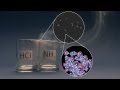
Understanding Ammonia and Hydrogen Chloride Reactions

Interactive Video
•
Chemistry, Science
•
8th - 12th Grade
•
Practice Problem
•
Hard

Lucas Foster
FREE Resource
Read more
8 questions
Show all answers
1.
MULTIPLE CHOICE QUESTION
30 sec • 1 pt
What is a common property of hydrogen chloride and ammonia at room temperature?
They are liquids.
They are gases.
They are solids.
They are metals.
2.
MULTIPLE CHOICE QUESTION
30 sec • 1 pt
What happens when ammonia and hydrogen chloride vapors mix?
They form a liquid.
They form white smoke.
They form a colored gas.
They remain separate.
3.
MULTIPLE CHOICE QUESTION
30 sec • 1 pt
What role do small crystals of ammonium chloride play in the formation of smoke?
They dissolve in water.
They act as smoke particles.
They evaporate quickly.
They change color.
4.
MULTIPLE CHOICE QUESTION
30 sec • 1 pt
What is the key interaction between ammonia and hydrogen chloride molecules?
Ammonia donates a proton to hydrogen chloride.
Ammonia shares an electron pair with hydrogen chloride.
Hydrogen chloride shares an electron pair with ammonia.
Hydrogen chloride donates a proton to ammonia.
5.
MULTIPLE CHOICE QUESTION
30 sec • 1 pt
What is the result of the interaction between ammonia and hydrogen chloride?
Formation of oxygen gas.
Formation of water.
Formation of ammonium chloride.
Formation of nitrogen gas.
6.
MULTIPLE CHOICE QUESTION
30 sec • 1 pt
How do separate molecules of ammonium chloride form a crystal?
By combining together.
By evaporating.
By changing color.
By dissolving in water.
7.
MULTIPLE CHOICE QUESTION
30 sec • 1 pt
What happens to ammonium chloride particles as they grow larger?
They become too heavy to remain airborne.
They change color.
They dissolve in air.
They become lighter.
Access all questions and much more by creating a free account
Create resources
Host any resource
Get auto-graded reports

Continue with Google

Continue with Email

Continue with Classlink

Continue with Clever
or continue with

Microsoft
%20(1).png)
Apple

Others
Already have an account?

