
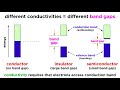
Understanding Conductivity and Semiconductors

Interactive Video
•
Physics, Chemistry, Science
•
9th - 12th Grade
•
Practice Problem
•
Hard

Olivia Brooks
FREE Resource
Read more
10 questions
Show all answers
1.
MULTIPLE CHOICE QUESTION
30 sec • 1 pt
What is the primary characteristic of a conductor?
It has a large band gap.
It allows the flow of electrical current.
It is made of small molecules.
It does not conduct electricity.
2.
MULTIPLE CHOICE QUESTION
30 sec • 1 pt
What happens when two atomic orbitals combine?
They create a lower-energy bonding orbital and a higher-energy antibonding orbital.
They lose their energy.
They become insulators.
They form a single molecular orbital.
3.
MULTIPLE CHOICE QUESTION
30 sec • 1 pt
What is the key feature of a conductor that allows it to conduct electricity?
Infinitesimally small energy difference between the highest occupied and lowest unoccupied molecular orbitals.
A large band gap.
High thermal energy.
Presence of impurities.
4.
MULTIPLE CHOICE QUESTION
30 sec • 1 pt
Why do semiconductors conduct electricity better at higher temperatures?
More thermal energy is available to promote electrons into the conduction band.
They become insulators.
They have a larger band gap.
They have more impurities.
5.
MULTIPLE CHOICE QUESTION
30 sec • 1 pt
Which of the following is a common element used as a semiconductor?
Copper
Aluminum nitride
Silicon
Diamond
6.
MULTIPLE CHOICE QUESTION
30 sec • 1 pt
What happens to a substance when its band gap becomes sufficiently large?
It becomes a superconductor.
It becomes an insulator.
It becomes a semiconductor.
It becomes a conductor.
7.
MULTIPLE CHOICE QUESTION
30 sec • 1 pt
What is the process of adding impurities to a semiconductor called?
Cooling
Doping
Heating
Mixing
Access all questions and much more by creating a free account
Create resources
Host any resource
Get auto-graded reports

Continue with Google

Continue with Email

Continue with Classlink

Continue with Clever
or continue with

Microsoft
%20(1).png)
Apple

Others
Already have an account?


