
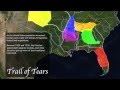
Indian Removal Act and the Trail of Tears

Interactive Video
•
History, Social Studies
•
6th - 10th Grade
•
Practice Problem
•
Medium

Emma Peterson
Used 11+ times
FREE Resource
Read more
5 questions
Show all answers
1.
MULTIPLE CHOICE QUESTION
30 sec • 1 pt
In which decade did the U.S. Congress pass the Indian Removal Act?
1820s
1830s
1850s
1840s
2.
MULTIPLE CHOICE QUESTION
30 sec • 1 pt
Which of the following tribes was NOT one of the five civilized tribes affected by the Indian Removal Act?
Cherokees
Creeks
Seminoles
Navajos
3.
MULTIPLE CHOICE QUESTION
30 sec • 1 pt
To which territory were the five civilized tribes relocated?
New Mexico
Texas
California
Oklahoma
4.
MULTIPLE CHOICE QUESTION
30 sec • 1 pt
What was the name given to the forced relocation that resulted in many deaths?
The Great Migration
The Trail of Tears
The Forced Walk
The Long March
5.
MULTIPLE CHOICE QUESTION
30 sec • 1 pt
Which of the following best describes the Trail of Tears?
A voluntary migration
A peaceful negotiation
A forced relocation with significant hardship
A successful settlement
Access all questions and much more by creating a free account
Create resources
Host any resource
Get auto-graded reports

Continue with Google

Continue with Email

Continue with Microsoft
or continue with

%20(1).png)
Apple

Others
Already have an account?

