
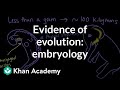
Homologous Features and Embryonic Development

Interactive Video
•
Biology, Science
•
5th - 8th Grade
•
Practice Problem
•
Medium

Sophia Harris
Used 30+ times
FREE Resource
Read more
10 questions
Show all answers
1.
MULTIPLE CHOICE QUESTION
30 sec • 1 pt
What is an embryo?
A type of cell
A fully developed organism
An organism in its earliest stages of development
A part of the human spine
2.
MULTIPLE CHOICE QUESTION
30 sec • 1 pt
What happens to the embryonic tail in humans?
It disappears completely
It remains visible throughout life
It transforms into the tailbone
It becomes part of the brain
3.
MULTIPLE CHOICE QUESTION
30 sec • 1 pt
Which of the following is an example of a homologous feature?
Wings of a butterfly and a bat
Leaves of a tree and petals of a flower
Embryo tails in vertebrates
Fins of a fish and wings of a bird
4.
MULTIPLE CHOICE QUESTION
30 sec • 1 pt
Why are homologous features important to scientists?
They show the lifespan of species
They reveal the color patterns of animals
They indicate common ancestry and evolutionary relationships
They help identify the diet of species
5.
MULTIPLE CHOICE QUESTION
30 sec • 1 pt
What is a pharyngeal arch?
A structure that develops into gills in all animals
A structure found only in fish
A structure found in vertebrate embryos that can develop into different features
A part of the human brain
6.
MULTIPLE CHOICE QUESTION
30 sec • 1 pt
In which species do pharyngeal arches develop into gill structures?
Fish
Humans
Elephants
Birds
7.
MULTIPLE CHOICE QUESTION
30 sec • 1 pt
What do pharyngeal arches develop into in humans?
Tail structures
Wings
Legs
Ear and jaw structures
Access all questions and much more by creating a free account
Create resources
Host any resource
Get auto-graded reports

Continue with Google

Continue with Email

Continue with Classlink

Continue with Clever
or continue with

Microsoft
%20(1).png)
Apple

Others
Already have an account?


