
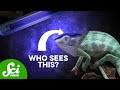
Fluorescence in Chameleons and Other Animals

Interactive Video
•
Biology, Science
•
6th - 10th Grade
•
Practice Problem
•
Hard

Liam Anderson
FREE Resource
Read more
10 questions
Show all answers
1.
MULTIPLE CHOICE QUESTION
30 sec • 1 pt
What is the main topic introduced in the video?
The history of Linode
Fluorescence in chameleons
The diet of chameleons
The anatomy of chameleons
2.
MULTIPLE CHOICE QUESTION
30 sec • 1 pt
What did scientists discover about chameleon bones under blacklight?
They change color
They become invisible
They absorb all light
They glow blue
3.
MULTIPLE CHOICE QUESTION
30 sec • 1 pt
Why are bones not visible through human skin under blacklight?
They are too dense
The light they emit is too weak
They do not fluoresce
Human skin is too thick
4.
MULTIPLE CHOICE QUESTION
30 sec • 1 pt
What unique feature do chameleons have that allows their bones to shine through?
Transparent skin
Tubercles close to the skin surface
Special pigments in their skin
Reflective scales
5.
MULTIPLE CHOICE QUESTION
30 sec • 1 pt
Which other animal besides chameleons has been observed to have glowing bones?
Jellyfish
Fireflies
Glow worms
Pumpkin toadlets
6.
MULTIPLE CHOICE QUESTION
30 sec • 1 pt
What is a possible reason for animals to evolve glowing bones?
To aid in digestion
For communication purposes
To attract predators
To regulate body temperature
7.
MULTIPLE CHOICE QUESTION
30 sec • 1 pt
What are some potential uses of fluorescence in animal communication?
Territorial marking and mating
Hunting prey
Thermoregulation
Camouflage
Access all questions and much more by creating a free account
Create resources
Host any resource
Get auto-graded reports

Continue with Google

Continue with Email

Continue with Classlink

Continue with Clever
or continue with

Microsoft
%20(1).png)
Apple

Others
Already have an account?

