
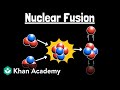
Understanding Nuclear Fusion and Element Formation

Interactive Video
•
Physics, Chemistry, Science
•
9th - 12th Grade
•
Practice Problem
•
Medium

Liam Anderson
Used 20+ times
FREE Resource
Read more
10 questions
Show all answers
1.
MULTIPLE CHOICE QUESTION
30 sec • 1 pt
What were the primary elements present in the early universe after the Big Bang?
Iron, nickel, and cobalt
Gold, silver, and platinum
Oxygen, carbon, and nitrogen
Hydrogen, helium, and traces of lithium
2.
MULTIPLE CHOICE QUESTION
30 sec • 1 pt
What is the process called when smaller nuclei combine to form a larger nucleus?
Nuclear fission
Nuclear fusion
Chemical reaction
Radioactive decay
3.
MULTIPLE CHOICE QUESTION
30 sec • 1 pt
Why do nuclear fusion reactions primarily occur in the cores of stars?
Because of the presence of water
Due to high temperatures and pressures
Because of low gravity
Due to the presence of oxygen
4.
MULTIPLE CHOICE QUESTION
30 sec • 1 pt
What principle explains the energy release in nuclear fusion reactions?
Newton's Third Law
Law of Conservation of Momentum
Heisenberg's Uncertainty Principle
Mass-Energy Equivalence
5.
MULTIPLE CHOICE QUESTION
30 sec • 1 pt
What happens to the mass of the products compared to the reactants in a nuclear fusion reaction?
The mass of the products is greater
The mass of the products is less
The mass remains the same
The mass doubles
6.
MULTIPLE CHOICE QUESTION
30 sec • 1 pt
What is the primary fusion reaction occurring in our sun?
Fusion of helium into carbon
Fusion of carbon into oxygen
Fusion of protons into helium
Fusion of iron into heavier elements
7.
MULTIPLE CHOICE QUESTION
30 sec • 1 pt
What marks the end of the fusion chain in stars?
Formation of helium
Formation of carbon
Formation of iron
Formation of uranium
Access all questions and much more by creating a free account
Create resources
Host any resource
Get auto-graded reports

Continue with Google

Continue with Email

Continue with Classlink

Continue with Clever
or continue with

Microsoft
%20(1).png)
Apple

Others
Already have an account?


