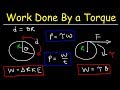
Understanding Work, Torque, and Power

Interactive Video
•
Physics, Science
•
9th - 12th Grade
•
Practice Problem
•
Hard

Liam Anderson
FREE Resource
Read more
10 questions
Show all answers
1.
MULTIPLE CHOICE QUESTION
30 sec • 1 pt
What is the relationship between linear displacement and angular displacement in the context of work done by torque?
Linear displacement is the product of angular displacement and radius.
Linear displacement is the square of angular displacement.
Linear displacement is the difference between angular displacement and radius.
Linear displacement is the sum of angular displacement and radius.
2.
MULTIPLE CHOICE QUESTION
30 sec • 1 pt
How do you convert rotations to radians?
Multiply the number of rotations by π.
Multiply the number of rotations by 2π.
Divide the number of rotations by 2π.
Divide the number of rotations by π.
3.
MULTIPLE CHOICE QUESTION
30 sec • 1 pt
What is the formula for calculating average power exerted by a torque?
Power is work divided by angular displacement.
Power is work multiplied by time.
Power is torque multiplied by angular velocity.
Power is torque divided by angular velocity.
4.
MULTIPLE CHOICE QUESTION
30 sec • 1 pt
In the context of maintaining a constant angular speed, what is the relationship between torque and angular velocity?
Torque is inversely proportional to angular velocity.
Torque is directly proportional to angular velocity.
Torque is equal to angular velocity squared.
Torque is independent of angular velocity.
5.
MULTIPLE CHOICE QUESTION
30 sec • 1 pt
How do you calculate the work done by a torque over a period of time?
Multiply power by time.
Divide power by time.
Multiply torque by angular displacement.
Divide torque by angular displacement.
6.
MULTIPLE CHOICE QUESTION
30 sec • 1 pt
What is the initial rotational kinetic energy of a disc that starts from rest?
It is equal to the final rotational kinetic energy.
It is half of the final rotational kinetic energy.
It is zero.
It is equal to the work done on the disc.
7.
MULTIPLE CHOICE QUESTION
30 sec • 1 pt
How is the inertia of a solid disc calculated?
Inertia is radius squared divided by mass.
Inertia is half of mass times radius squared.
Inertia is mass times radius squared.
Inertia is mass divided by radius squared.
Access all questions and much more by creating a free account
Create resources
Host any resource
Get auto-graded reports

Continue with Google

Continue with Email

Continue with Classlink

Continue with Clever
or continue with

Microsoft
%20(1).png)
Apple

Others
Already have an account?
Popular Resources on Wayground

7 questions
History of Valentine's Day
Interactive video
•
4th Grade
15 questions
Fractions on a Number Line

Quiz
•
3rd Grade
20 questions
Equivalent Fractions
Quiz
•
3rd Grade
25 questions
Multiplication Facts
Quiz
•
5th Grade
22 questions
fractions
Quiz
•
3rd Grade
15 questions
Valentine's Day Trivia
Quiz
•
3rd Grade
20 questions
Main Idea and Details
Quiz
•
5th Grade
20 questions
Context Clues
Quiz
•
6th Grade
Discover more resources for Physics
10 questions
Exit Check 3.1 - Kepler's Laws
Quiz
•
9th Grade
10 questions
Exit Check 3.2 - Force of Gavity
Quiz
•
9th Grade
21 questions
Potential and Kinetic Energy
Quiz
•
11th Grade
27 questions
Simple Machines and Mechanical Advantage Quiz
Quiz
•
9th Grade
15 questions
Circuits Review Quiz
Quiz
•
12th Grade
20 questions
Unit 8 - Energy Test - 2025-2026
Quiz
•
9th - 12th Grade
19 questions
Generators, Motors, and Transformers
Quiz
•
8th Grade - University
13 questions
Series Circuits and Parallel Circuits
Quiz
•
12th Grade