
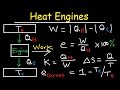
Thermodynamics and Heat Engines Quiz

Interactive Video
•
Physics, Science
•
10th - 12th Grade
•
Practice Problem
•
Hard

Ethan Morris
Used 1+ times
FREE Resource
Read more
10 questions
Show all answers
1.
MULTIPLE CHOICE QUESTION
30 sec • 1 pt
What is a key characteristic of irreversible processes according to the second law of thermodynamics?
They require external energy to occur.
They increase the disorder of a system.
They can occur in both directions without energy input.
They decrease the disorder of a system.
2.
MULTIPLE CHOICE QUESTION
30 sec • 1 pt
In a heat engine, what is the relationship between the work done and the heat absorbed?
Work done is independent of heat absorbed.
Work done is the difference between heat absorbed and heat expelled.
Work done is the sum of heat absorbed and heat expelled.
Work done is equal to the heat absorbed.
3.
MULTIPLE CHOICE QUESTION
30 sec • 1 pt
How is the efficiency of a heat engine calculated?
Efficiency is the ratio of work done to heat expelled.
Efficiency is the ratio of heat expelled to heat absorbed.
Efficiency is the ratio of work done to heat absorbed.
Efficiency is the ratio of heat absorbed to work done.
4.
MULTIPLE CHOICE QUESTION
30 sec • 1 pt
What is the Carnot cycle primarily used to represent?
The efficiency of a refrigerator.
The average efficiency of real-world engines.
The maximum possible efficiency of a heat engine.
The least efficient heat engine model.
5.
MULTIPLE CHOICE QUESTION
30 sec • 1 pt
What is the purpose of a refrigerator in terms of heat transfer?
To transfer heat from a hot reservoir to a cold reservoir.
To maintain a constant temperature in both reservoirs.
To convert mechanical work into heat.
To transfer heat from a cold reservoir to a hot reservoir.
6.
MULTIPLE CHOICE QUESTION
30 sec • 1 pt
What is the coefficient of performance for a refrigerator that removes 1500 joules of heat from a cold reservoir and requires 420 joules of work?
4.0
2.5
3.57
1.8
7.
MULTIPLE CHOICE QUESTION
30 sec • 1 pt
In the autocycle, what happens during the adiabatic compression phase?
Volume increases and temperature decreases
Volume decreases and temperature increases
Pressure decreases and temperature remains constant
Volume remains constant and pressure decreases
Access all questions and much more by creating a free account
Create resources
Host any resource
Get auto-graded reports

Continue with Google

Continue with Email

Continue with Classlink

Continue with Clever
or continue with

Microsoft
%20(1).png)
Apple

Others
Already have an account?


