
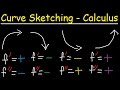
Understanding Curve Sketching with Derivatives

Interactive Video
•
Mathematics
•
10th - 12th Grade
•
Practice Problem
•
Hard
+1
Standards-aligned

Ethan Morris
FREE Resource
Standards-aligned
Read more
10 questions
Show all answers
1.
MULTIPLE CHOICE QUESTION
30 sec • 1 pt
What does a positive first derivative indicate about a function's behavior?
The function is concave down.
The function is constant.
The function is increasing.
The function is decreasing.
2.
MULTIPLE CHOICE QUESTION
30 sec • 1 pt
If a graph is concave up, what can be said about the second derivative?
The second derivative is zero.
The second derivative is positive.
The second derivative is negative.
The second derivative is undefined.
Tags
CCSS.HSF.IF.B.4
3.
MULTIPLE CHOICE QUESTION
30 sec • 1 pt
Which of the following describes a graph where both the first and second derivatives are positive?
The graph is decreasing at an increasing rate.
The graph is increasing at an increasing rate.
The graph is decreasing at a decreasing rate.
The graph is increasing at a decreasing rate.
Tags
CCSS.8.F.B.4
CCSS.HSF.IF.B.6
4.
MULTIPLE CHOICE QUESTION
30 sec • 1 pt
What is the shape of a graph when the first derivative is negative and the second derivative is positive?
Decreasing and concave down
Increasing and concave down
Increasing and concave up
Decreasing and concave up
5.
MULTIPLE CHOICE QUESTION
30 sec • 1 pt
In the polynomial example, what is the significance of a critical point?
It is where the function has a local maximum or minimum.
It is where the function is constant.
It is where the function is undefined.
It is where the function changes concavity.
Tags
CCSS.HSF-IF.C.7D
6.
MULTIPLE CHOICE QUESTION
30 sec • 1 pt
How do you determine the vertical asymptote of a rational function?
Find where the second derivative is zero.
Set the numerator equal to zero.
Set the denominator equal to zero.
Find where the first derivative is zero.
7.
MULTIPLE CHOICE QUESTION
30 sec • 1 pt
What does it mean if the first derivative of a function is always positive?
The function is constant.
The function has a local maximum.
The function is always decreasing.
The function is always increasing.
Access all questions and much more by creating a free account
Create resources
Host any resource
Get auto-graded reports

Continue with Google

Continue with Email

Continue with Classlink

Continue with Clever
or continue with

Microsoft
%20(1).png)
Apple

Others
Already have an account?

