
Describing Trends_Advanced Revision
Authored by Tung-Linh Nguyen
English
University
Used 3+ times


AI Actions
Add similar questions
Adjust reading levels
Convert to real-world scenario
Translate activity
More...
Content View
Student View
7 questions
Show all answers
1.
CATEGORIZE QUESTION
5 mins • 5 pts
Organize these options into the right categories
Groups:
(a) Minimal Decrease
,
(b) Moderate/Gradual Decrease
,
(c) Sharp Decrease
,
(d) Moderate Increase
Low-skill jobs shrunk gradually over the years
Bachelor’s degrees continued to gain ground in the workforce
Economic conditions deteriorated slowly
GDP fell steeply during the recession
Oil prices plummeted amid market uncertainty
Productivity inched up slightly after stagnation.
The drop in unemployment tapered off by 2020
Investment levels have flatlined since the slowdown
Job growth has stagnated in the manufacturing sector.
2.
MULTIPLE CHOICE QUESTION
3 mins • Ungraded
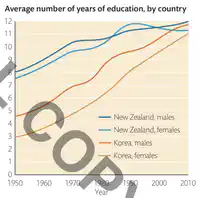
Choose what you think is the best Overview:
Overall, both countries experienced significant increases in educational attainment over the six decades, though the trends diverged in pace and timing. By 2010, education levels in Korea had surpassed those in New Zealand, particularly for females, after decades of consistent growth.
It highlights how Korea, starting from a much lower base, rapidly closed the educational gap with New Zealand and ultimately surpassed it.
This chart is more than numbers and lines; it is a portrait of ambition and reform. New Zealand maintained its steady course, while Korea executed a breathtaking sprint. Together, they highlight a broader truth: the closing of the educational gender gap.
The chart illustrates a quiet but profound shift in education across two nations—New Zealand and Korea—over six decades. What begins as a story of clear educational disparity ends in parity, with Korea’s remarkable rise reshaping the narrative.
3.
DROPDOWN QUESTION
2 mins • 2 pts
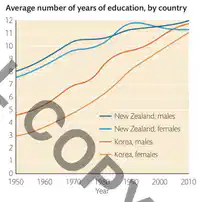
In 1950, New Zealand enjoyed a clear advantage, with men averaging around nine years of education and women (a) to eight. Education levels rose (b) over the next 60 years, with both genders reaching (c) at around 12 years by 2010.
4.
DROPDOWN QUESTION
3 mins • 2 pts
In 1950, Korean males had (a) four years of education on average, (b) females lagged even further behind at under three. Yet the country embarked on a rapid (c) trajectory, with male attainment surpassing eight years by 1980 and (d) nearly 12 by 2010. Perhaps most strikingly, Korean women—once far behind—saw their educational levels (e) , overtaking their New Zealand counterparts in the early 2000s and achieving equality with Korean men at 12 years by the end of the period.
5.
FILL IN THE BLANKS QUESTION
1 min • 1 pt
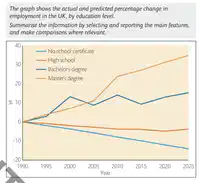
Write the correct formation of the word in bracket: The graph highlights the actual and projected percentage change in employment in the UK between 1990 and 2025, segmented by education level. It reveals a striking (a) (CORRELATE): the higher the level of education, the greater the likelihood of employment growth, while those with little or no qualifications face a downward trend
6.
WORD CLOUD QUESTION
1 min • Ungraded
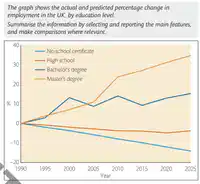
Write what you think is appropriate in the blank. ADVERB ONLY!!!!
In contrast, employment prospects for those with a high school education or no school certificate show a ............ different trajectory
7.
DROPDOWN QUESTION
5 mins • 5 pts
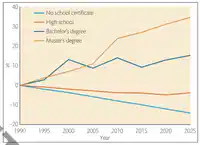
Similarly, individuals with a Bachelor’s degree have seen steady increases, though at a slower (a) . Employment for this cohort (b) around 2000, (c) slightly in the following decade, and is expected to (d) to roughly 15% by 2025.
Access all questions and much more by creating a free account
Create resources
Host any resource
Get auto-graded reports

Continue with Google

Continue with Email

Continue with Classlink

Continue with Clever
or continue with

Microsoft
%20(1).png)
Apple

Others
Already have an account?

