
Formation of the Solar System
Authored by Tyler Forney
Biology
9th Grade
NGSS covered
Used 19+ times


AI Actions
Add similar questions
Adjust reading levels
Convert to real-world scenario
Translate activity
More...
Content View
Student View
23 questions
Show all answers
1.
MULTIPLE CHOICE QUESTION
30 sec • 1 pt
Scientists have identified several pieces of evidence from our own planets that help explain how the solar system formed. Which statement best represents this evidence?
All terrestrial planets are rocky, indicating a common origin of solid materials in the inner solar system.
Most of the planets are made of ice, suggesting a colder origin of the solar system.
The planets rotate in different directions, showing diverse formation processes.
The planets all orbit within a few degrees of a common plane, supporting the idea of a flattened disk formation.
Answer explanation
The statement about planets orbiting within a few degrees of a common plane supports the idea of a flattened disk formation, which is a key concept in understanding how the solar system formed.
Tags
NGSS.HS-ESS1-6
2.
MULTIPLE CHOICE QUESTION
30 sec • 1 pt
Which of the following best describes how the model illustrates the formation of the solar system according to the Solar Nebular Theory?
The model demonstrates that the solar system formed from a meteoroid impact that created the Sun and planets.
The model demonstrates that a nebula began to collapse under its own gravity, spinning faster and flattening into a disk shape, forming the Sun in the center, with planets revolving around it.
The model demonstrates that gravity pulled comets together to form terrestrial planets and gas giants.
The model demonstrates that asteroids collided to form the Sun and planets, which then revolved around the asteroid belt.
Answer explanation
The correct choice explains that the solar system formed from a collapsing nebula, which spun and flattened into a disk, with the Sun at the center and planets forming around it, aligning with the Solar Nebular Theory.
Tags
NGSS.MS-ESS1-2
3.
MULTIPLE CHOICE QUESTION
30 sec • 1 pt
How can a model best illustrate the role of gravity in the formation of the solar system according to the Solar Nebular Theory?
By showing planets orbiting in perfect circles.
By demonstrating the collapse of the solar nebula under gravity, leading to the formation of the Sun and planets.
By depicting the Sun losing mass over time.
By showing gravity pushing planets away from each other.
Answer explanation
The correct choice illustrates how gravity causes the solar nebula to collapse, forming the Sun and planets, which is central to the Solar Nebular Theory. Other options do not accurately represent this fundamental process.
Tags
NGSS.MS-ESS1-2
4.
MULTIPLE CHOICE QUESTION
30 sec • 1 pt
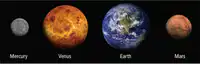
Examine the model below showing the four terrestrial planets: Mercury, Venus, Earth, and Mars. Based on the model, which statement correctly describes the characteristics and location of these planets in the solar system?
Mercury, Venus, Earth, and Mars are located far from the Sun and are known for their gaseous atmosphere.
The terrestrial planets are located close to the Sun and are characterized by their rocky surfaces and dense compositions.
These planets are located in the outer region of the solar system and have low densities compared to the gas giants.
The model shows that terrestrial planets have extensive ring systems and are primarily composed of hydrogen and helium.
Answer explanation
The correct choice states that terrestrial planets are close to the Sun and have rocky surfaces. This accurately describes Mercury, Venus, Earth, and Mars, distinguishing them from gas giants, which are located farther out.
5.
MULTIPLE CHOICE QUESTION
30 sec • 1 pt
In your scale model, how should the sizes and distances of the Sun, terrestrial planets, and Jovian planets be represented?
The Sun should be significantly larger than all planets; terrestrial planets should be smaller and closer to the Sun; Jovian planets should be larger and farther from the Sun.
The Sun, terrestrial planets, and Jovian planets should all be represented as the same size; distances should be equal between all planets.
Jovian planets should be shown as smaller and closer to the Sun, while terrestrial planets should be larger and farther from the Sun.
The Sun should be represented as smaller than all planets; terrestrial planets should be shown farther from the Sun than Jovian planets.
Answer explanation
The correct choice accurately reflects the relative sizes and distances in our solar system: the Sun is much larger than the planets, terrestrial planets are smaller and closer, while Jovian planets are larger and farther away.
Tags
NGSS.MS-ESS1-2
NGSS.MS-ESS1-3
6.
MULTIPLE CHOICE QUESTION
30 sec • 1 pt
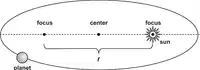
Students are studying the orbits of planets and have been provided with the eccentricity (E) values for four planets: Mercury (E = 0.206), Venus (E = 0.007), Earth (E = 0.017), and Mars (E = 0.093). Based on the eccentricity values provided, which planet's orbit is the most elliptical and why?
Mercury, because it has the greatest distance between the foci.
Venus, because it has the smallest distance between the foci.
Earth, because it has a balanced distance between the foci.
Mars, because it has a moderate distance between the foci.
Answer explanation
Mercury has the highest eccentricity value (0.206), indicating its orbit is the most elliptical. A higher eccentricity means a greater distance between the foci of the ellipse, making Mercury's orbit more elongated than the others.
Tags
NGSS.MS-ESS1-3
7.
MULTIPLE CHOICE QUESTION
30 sec • 1 pt
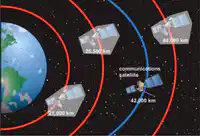
Kepler’s third law states that the ratio of the squares of the periods to the cubes of their orbital radii, T2/R3, is the same for all objects orbiting a body. Communication satellites are in synchronous orbits, which keep them directly above a specific location on Earth. The satellites that are part of the Global Positioning System (GPS) orbit Earth twice per day. If the orbital radius of a communications satellite is 42,000 km, what is the orbital radius of a GPS satellite? Choose the correct value.
21,000 km
26,500 km
42,000 km
82,000 km
Answer explanation
According to Kepler's third law, T²/R³ is constant. A GPS satellite orbits Earth twice a day, meaning its period is half that of a synchronous satellite. Thus, its orbital radius is 26,500 km, which satisfies the ratio.
Tags
NGSS.MS-ESS1-2
NGSS.MS-ESS1-3

Access all questions and much more by creating a free account
Create resources
Host any resource
Get auto-graded reports

Continue with Google

Continue with Email

Continue with Classlink

Continue with Clever
or continue with

Microsoft
%20(1).png)
Apple

Others
Already have an account?


