
Polynomial Degree and End Behaviors
Authored by Anthony Clark
Mathematics
11th Grade
CCSS covered


AI Actions
Add similar questions
Adjust reading levels
Convert to real-world scenario
Translate activity
More...
Content View
Student View
20 questions
Show all answers
1.
MULTIPLE CHOICE QUESTION
1 min • 1 pt
Rises to the left and falls to the right
Falls to the left and rises to the right
Rises to both direction
Falls to both direction
2.
MULTIPLE CHOICE QUESTION
1 min • 1 pt


3.
MULTIPLE CHOICE QUESTION
1 min • 1 pt


4.
MULTIPLE CHOICE QUESTION
1 min • 1 pt


5.
MULTIPLE CHOICE QUESTION
1 min • 1 pt
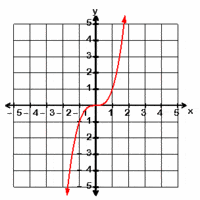
Describe the end behavior of the graph.
x → -∞, f(x) → ∞ and x→∞, f(x) →⁻∞
x → -∞, f(x) → ∞ and x→∞, f(x) →∞
x → -∞, f(x) → ∞ and x→∞, f(x) → 0
x → -∞,f(x) → -∞and x→ ∞, f(x) → ∞
6.
MULTIPLE CHOICE QUESTION
1 min • 1 pt

The end behavior can be written as: x→∞, y→? and as x→−∞, y→?
7.
MULTIPLE CHOICE QUESTION
1 min • 5 pts

Is the leading coefficient positive or negative? Why?
The leading coefficient is POSITIVE because the RIGHT SIDE goes UP.
The leading coefficient is NEGATIVE because the RIGHT SIDE goes UP.
The leading coefficient is POSITIVE because the RIGHT SIDE goes DOWN.
The leading coefficient is NEGATIVE because the RIGHT SIDE goes DOWN.

Access all questions and much more by creating a free account
Create resources
Host any resource
Get auto-graded reports

Continue with Google

Continue with Email

Continue with Classlink

Continue with Clever
or continue with

Microsoft
%20(1).png)
Apple

Others
Already have an account?

