
Reading Linear Equations on a Graph
Authored by Anthony Clark
Mathematics
9th Grade
CCSS covered


AI Actions
Add similar questions
Adjust reading levels
Convert to real-world scenario
Translate activity
More...
Content View
Student View
11 questions
Show all answers
1.
MULTIPLE CHOICE QUESTION
1 min • 1 pt

What is the y-intercept of the line graphed below?
3
4
-3
4/3
2.
MULTIPLE CHOICE QUESTION
1 min • 1 pt

What is the y-intercept of the line?
1/2
1
-1/2
-1
3.
MULTIPLE CHOICE QUESTION
1 min • 1 pt
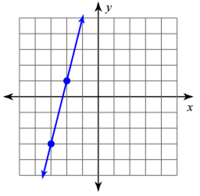
Find the slope of the line.
1/4
-1/4
-4
4
Tags
CCSS.8.EE.B.5
4.
MULTIPLE CHOICE QUESTION
1 min • 1 pt

Find the slope of the table
3
-3
20
Not a constant slope/Non-Linear
Tags
CCSS.8.EE.B.5
5.
MULTIPLE CHOICE QUESTION
1 min • 1 pt

what is the slope of the table (hint think back to the pretest)
1
2
11
Not a constant slope/Non-Linear
Tags
CCSS.8.EE.B.5
6.
MULTIPLE CHOICE QUESTION
1 min • 1 pt

What is the rate of change (slope) of the line shown?
40/1
50/1
10/1
1/10
Tags
CCSS.8.EE.B.5
7.
MULTIPLE SELECT QUESTION
1 min • 1 pt
When y=\frac{2}{3}x and y=\frac{2}{3}x+4 are graphed on the same coordinate plane, how are they related to each other geometrically?
They have different starting points (y-intercepts).
They have different slopes.
They have the same slopes and will create intersecting lines.
They have the same slopes and will create parallel lines.
is a translation of 4 units down.


Access all questions and much more by creating a free account
Create resources
Host any resource
Get auto-graded reports

Continue with Google

Continue with Email

Continue with Classlink

Continue with Clever
or continue with

Microsoft
%20(1).png)
Apple

Others
Already have an account?
Similar Resources on Wayground

16 questions
Actividad 11: Multiplicación de signos

Quiz
•
9th Grade
10 questions
Hulkliikmete summa ja vahe
Quiz
•
8th - 9th Grade
13 questions
Productos Notables - Factorización
Quiz
•
8th - 10th Grade
10 questions
Term2 revision for the monthly test y3
Quiz
•
3rd Grade - University
12 questions
Álgebra Int. 9-R
Quiz
•
1st - 12th Grade
12 questions
Revision - BOMDAS, Rates, Ratios, Best buys and Percentages
Quiz
•
9th - 10th Grade
10 questions
ECUACIONES DE PRIMER GRADO
Quiz
•
8th - 9th Grade
10 questions
Cuestionario Lógica
Quiz
•
4th - 11th Grade
Popular Resources on Wayground
15 questions
Fractions on a Number Line
Quiz
•
3rd Grade
10 questions
Probability Practice
Quiz
•
4th Grade
15 questions
Probability on Number LIne
Quiz
•
4th Grade
20 questions
Equivalent Fractions
Quiz
•
3rd Grade
25 questions
Multiplication Facts
Quiz
•
5th Grade
22 questions
fractions
Quiz
•
3rd Grade
6 questions
Appropriate Chromebook Usage

Lesson
•
7th Grade
10 questions
Greek Bases tele and phon
Quiz
•
6th - 8th Grade
Discover more resources for Mathematics
15 questions
Graphing Inequalities
Quiz
•
7th - 9th Grade
20 questions
Graphing Inequalities on a Number Line
Quiz
•
6th - 9th Grade
15 questions
Combine Like Terms and Distributive Property
Quiz
•
8th - 9th Grade
10 questions
Plotting Points on a Coordinate Plane: Quadrant 1 Essentials

Interactive video
•
6th - 10th Grade
20 questions
Perfect Squares and Square Roots
Quiz
•
9th Grade
10 questions
Exploring Abiotic and Biotic Factors in Ecosystems
Interactive video
•
6th - 10th Grade
20 questions
Function or Not a Function
Quiz
•
8th - 9th Grade
20 questions
SSS/SAS
Quiz
•
9th - 12th Grade