
Respiratory System
9th - 12th Grade
•23 Qs

Similar activities
DNA and RNA
10th Grade
•20 Qs
Review Pressure
8th Grade - University
•18 Qs
NHA MODULE 1: Pharmacy Technician Overview
12th Grade
•20 Qs
HSB Paper 1 2019 (1-20)
9th - 11th Grade
•20 Qs
KS3 Plant adaptations
4th Grade - University
•18 Qs
Kuiz Formatif SVM2 SEM4 2023
10th Grade
•20 Qs
Pneumatics
10th Grade
•20 Qs
SpaceOut'22 Pre-Event
5th - 12th Grade
•20 Qs
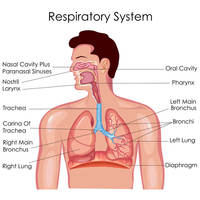
Respiratory System

Quiz
•
Science
•
9th - 12th Grade
•
Practice Problem
•
Hard
Standards-aligned

Nicholas Macaronis
Used 353+ times
FREE Resource

Enhance your content in a minute
23 questions
Show all answers
1.
MULTIPLE CHOICE QUESTION
30 sec • 1 pt
In order for oxygen to diffuse into the blood during inhalation, what is true about blood concentration?
both gases are at equivalent levels
carbon dioxide levels are low
oxygen levels are high
oxygen levels are low
2.
MULTIPLE CHOICE QUESTION
30 sec • 1 pt
If Eurythrocytes only carry about 15% of the CO2 produced by cellular respiration, why would an individual with anemia report shortness of breath?
Fewer red blood cells to convert CO2 to HCO3- + H+ in the blood will trigger an increase in the pH and a decrease in ventilation, or shortness of breath.
Fewer red blood cells to convert CO2 to HCO3- + H+ in the blood will result in a decreased pH and an increase in ventilation, or shortness of breath.
Fewer red blood cells convert HCO3- into H+ and CO2 in the plasma triggering an decrease in ventilation, or shortness of breath.
Fewer red blood cells convert HCO3- into H+ and CO2 in the plasma triggering an increase in ventilation, or shortness of breath.
Tags
NGSS.HS-LS1-3
3.
MULTIPLE CHOICE QUESTION
30 sec • 1 pt
What is the compound called when oxygen binds with hemoglobin in a person?
oxyplasma
oxyhemoglobin
carbon dioxide
bicarbonate ion
4.
MULTIPLE CHOICE QUESTION
30 sec • 1 pt
Which of the following would be a direct result of this Emphysema?
alveoli would be unable to distribute air equally throughout the lungs
capillaries surrounding the alveoli would absorb excess carbon dioxide
lower amounts of oxygen would diffuse across the membranes of alveoli into the bloodstream
less particulate matter would be trapped by mucous in the alveoli
5.
MULTIPLE CHOICE QUESTION
30 sec • 1 pt
Which of the following accurately describes the relationship between the gas laws and pulmonary ventilation?
When the intercostals contract, the lung volume increases causing exhalation.
When the intercostals contract, the lung volume increases causing inhalation.
When the diaphragm contracts, lung volume increases causing a decrease in pressure leading to inhalation.
When the diaphragm contracts, lung volume increases causing a decrease in pressure leading to exhalation.
6.
MULTIPLE CHOICE QUESTION
30 sec • 1 pt
What is the process called when air moves in and out of the lungs?
internal respiration
internal ventilation
external respiration
pulmonary ventilation
7.
MULTIPLE CHOICE QUESTION
30 sec • 1 pt
Which molecules transport the majority of the carbon dioxide in the blood?
carbohemoglobin
bicarbonate ions
hydrogen ions
oxyhemoglobin
Access all questions and much more by creating a free account
Create resources
Host any resource
Get auto-graded reports

Continue with Google

Continue with Email

Continue with Classlink

Continue with Clever
or continue with

Microsoft
%20(1).png)
Apple

Others
Already have an account?
Similar Resources on Wayground
20 questions
Year 10 Science - Motion and forces quiz
Quiz
•
10th Grade
20 questions
Cell Organelles
Quiz
•
8th - 10th Grade
22 questions
Unit 2 - Matter - Practice Test (Minor Grade)
Quiz
•
12th Grade
20 questions
U4 AOS 1 - Sleep and Consciousness Part 1
Quiz
•
12th Grade
20 questions
Water Cycle
Quiz
•
9th Grade
20 questions
X IPS 4 TEORI TERJADINYA BUMI PERBAIKAN NILAI
Quiz
•
10th - 12th Grade
20 questions
Energy Sources
Quiz
•
7th - 10th Grade
20 questions
Acids and Bases in Everyday Life
Quiz
•
9th - 12th Grade
Popular Resources on Wayground
15 questions
Fractions on a Number Line
Quiz
•
3rd Grade
20 questions
Equivalent Fractions
Quiz
•
3rd Grade
25 questions
Multiplication Facts
Quiz
•
5th Grade
22 questions
fractions
Quiz
•
3rd Grade
20 questions
Main Idea and Details
Quiz
•
5th Grade
20 questions
Context Clues
Quiz
•
6th Grade
15 questions
Equivalent Fractions
Quiz
•
4th Grade
20 questions
Figurative Language Review
Quiz
•
6th Grade
Discover more resources for Science
10 questions
Exploring the Layers of the Earth

Interactive video
•
6th - 10th Grade
25 questions
Naming Ionic and Covalent Compounds
Quiz
•
9th Grade
14 questions
Natural Selection and Adaptation

Lesson
•
9th - 12th Grade
20 questions
Atomic Structure
Quiz
•
9th Grade
10 questions
Exploring the Ring of Fire: Volcanoes and Earthquakes
Interactive video
•
6th - 10th Grade
38 questions
Water Cycle and Groundwater
Quiz
•
9th - 12th Grade
10 questions
Exploring Spring and Neap Tides
Interactive video
•
6th - 10th Grade
15 questions
DNA and RNA review
Quiz
•
9th Grade