
Evolution and Dna
Authored by Charles Martinez
Science
10th Grade
NGSS covered
Used 3+ times


AI Actions
Add similar questions
Adjust reading levels
Convert to real-world scenario
Translate activity
More...
Content View
Student View
20 questions
Show all answers
1.
MULTIPLE CHOICE QUESTION
30 sec • 1 pt

Evolution is best defined as:
the process which organisms die.
the process which organisms change over time.
the process which organisms that are extinct become revived.
the process which non-living things fossilize.
Tags
NGSS.HS-LS4-1
NGSS.HS-LS4-2
NGSS.HS-LS4-5
NGSS.HS-LS4-4
2.
MULTIPLE CHOICE QUESTION
30 sec • 1 pt

The solidified remain or imprint of a once living thing are called:
Fossils
Homologous Structures
Vestigial Structures
DNA
Tags
NGSS.MS-LS4-1
3.
MULTIPLE CHOICE QUESTION
30 sec • 1 pt

What type of evidence for evolution is represented in the picture above:
Fossils
Vestigial Structures
DNA
Homologous Structures
Tags
NGSS.HS-LS4-1
4.
MULTIPLE CHOICE QUESTION
30 sec • 1 pt
How does embryology support the Theory of Evolution?
It shows that they have a common ancestor because of their similarities.
I'm not sure.
Animals change over time.
it does what now
Tags
NGSS.HS-LS4-1
5.
MULTIPLE CHOICE QUESTION
30 sec • 1 pt

In stage one (top row) of these embryos, most of the embryos________
Tags
NGSS.HS-LS4-1
6.
MULTIPLE CHOICE QUESTION
30 sec • 1 pt
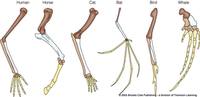
The similarities of the bones in the diagram provide evidence that---
Tags
NGSS.HS-LS4-1
7.
MULTIPLE CHOICE QUESTION
1 min • 1 pt

According to this cladogram, sharks are MOST closely related to which organism?
Tags
NGSS.HS-LS4-1
NGSS.HS-LS4-2
Access all questions and much more by creating a free account
Create resources
Host any resource
Get auto-graded reports

Continue with Google

Continue with Email

Continue with Microsoft
or continue with

%20(1).png)
Apple

Others
By signing up, you agree to our Terms of Service & Privacy Policy
Already have an account?



