
Using Absolute and Relative Age
8th Grade
•15 Qs

Similar activities
Scitech Quest
8th Grade
•15 Qs
Q1-W4-POST-TEST
8th Grade
•15 Qs
6th Grade CBA 4 Review
6th - 8th Grade
•20 Qs
Tectonic Activity
7th - 10th Grade
•10 Qs
Electricty and Magnetism
7th - 9th Grade
•15 Qs
Chapter 8: Force and Motion
8th Grade
•20 Qs
Cell division
7th - 11th Grade
•13 Qs
INTRODUCTION TO SCIENTIFIC INVESTIGATION
8th Grade
•10 Qs
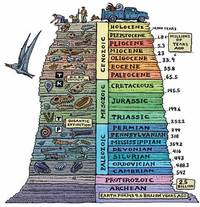
Using Absolute and Relative Age

Quiz
•
Science
•
8th Grade
•
Practice Problem
•
Hard
+1
Standards-aligned

Lisa Thompson
Used 1+ times
FREE Resource

Enhance your content in a minute
15 questions
Show all answers
1.
MULTIPLE CHOICE QUESTION
1 min • 1 pt
What is the difference between relative age and absolute age?
Relative is the age of a rock/fossil in relation to the rock layers around it, absolute age is the exact age of the rock/fossil.
Absolute age is the age of an object in relation to objects around it, relative age is the exact age of the object.
Relative age only applies to fossils, Absolute age only applies to rocks.
Absolute age only applies to fossils, Relative age only applies to rocks.
Tags
NGSS.MS-ESS1-4
2.
MULTIPLE CHOICE QUESTION
1 min • 1 pt
Average numerical age, in years of a rock or object.
Absolute Age
Relative Age
Half-life
Law of Universality
Tags
NGSS.HS-ESS1-5
3.
MULTIPLE CHOICE QUESTION
1 min • 1 pt
Two geologists were conducting a dig in a set of horizontal, undisturbed rock layers. They both discovered fossils in the same area, however, they would like to determine the exact age of their fossils. What is the BEST method for them to use to determine a more precise age of their fossils?
The Law of Superposition is the best way to determine the age of the fossil because whoever dug deeper into the Earth obtained the older fossil.
Using an index fossil is the best way to determine the age of the fossil because all fossils of the same species will be the same age.
Radiocarbon dating is the best way to determine the age of the fossils because it shows the amount of carbon decay in an organism that was once alive.
Using the fossil record is the best way to determine the age of the fossils because the fossil record has not changed over time.
Tags
NGSS.MS-ESS1-4
4.
MULTIPLE CHOICE QUESTION
1 min • 1 pt

What are the relative ages of the features in order from oldest to youngest?
Limestone, Basalt, Fault, Siltstone
Siltstone, Fault, Basalt, Limestone
Limestone, Fault, Basalt, Siltstone
Limestone, Siltstone, Fault, Basalt
Tags
NGSS.MS-ESS1-4
5.
MULTIPLE CHOICE QUESTION
1 min • 1 pt
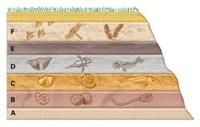
Which rock layer in the diagram seems to be the oldest?
F
E
B
A
Tags
NGSS.MS-ESS1-4
NGSS.MS-ESS2-3
6.
MULTIPLE CHOICE QUESTION
1 min • 1 pt

Which of the following correctly lists the layers in order from oldest to youngest?
A, B, C, D, E
E, B, C, D, A
E, D, C, B, A
C, B, A, D, E
Tags
NGSS.MS-ESS1-4
7.
MULTIPLE CHOICE QUESTION
1 min • 1 pt

Which is the youngest?
Layer B
Intrusion A
Layer C
Layer D
Tags
NGSS.MS-ESS1-4
Access all questions and much more by creating a free account
Create resources
Host any resource
Get auto-graded reports

Continue with Google

Continue with Email

Continue with Classlink

Continue with Clever
or continue with

Microsoft
%20(1).png)
Apple

Others
Already have an account?
Similar Resources on Wayground
20 questions
Energy: Potential and Kinetic
Quiz
•
8th Grade
19 questions
Forces, Newton's Laws, Electromagnets, & the Universe
Quiz
•
8th Grade
15 questions
Comp Sci 3 FSA Prep Day 6
Quiz
•
8th Grade
16 questions
Development of The Cell Theory.
Quiz
•
8th Grade
10 questions
Creating a report
Quiz
•
8th Grade
18 questions
Repeat for Test
Quiz
•
8th Grade
15 questions
TLE 8 - Cleaning and Sanitizing Kitchen Tools
Quiz
•
7th - 8th Grade
12 questions
Light, Shadow and Reflection
Quiz
•
5th - 10th Grade
Popular Resources on Wayground
15 questions
Fractions on a Number Line
Quiz
•
3rd Grade
20 questions
Equivalent Fractions
Quiz
•
3rd Grade
25 questions
Multiplication Facts
Quiz
•
5th Grade
22 questions
fractions
Quiz
•
3rd Grade
20 questions
Main Idea and Details
Quiz
•
5th Grade
20 questions
Context Clues
Quiz
•
6th Grade
15 questions
Equivalent Fractions
Quiz
•
4th Grade
20 questions
Figurative Language Review
Quiz
•
6th Grade
Discover more resources for Science
33 questions
Grade 6 Quarter 3 PMA 5 Review
Quiz
•
6th - 8th Grade
85 questions
Midpoint D1 Review
Quiz
•
8th Grade
12 questions
Newton's Laws of Motion

Lesson
•
6th - 8th Grade
10 questions
Exploring the Rock Cycle: Types and Formation

Interactive video
•
6th - 8th Grade
10 questions
Exploring the Layers of the Earth
Interactive video
•
6th - 10th Grade
20 questions
Pure Substances & Mixtures
Quiz
•
8th Grade
28 questions
Genes and Heredity
Lesson
•
8th Grade
24 questions
Subatomic Particles
Quiz
•
8th Grade