
7.3 APES ET
10th Grade
•5 Qs

Similar activities
GURUKULAM QUIZ #03
10th Grade
•10 Qs
Cell structure and organisation
9th - 11th Grade
•10 Qs
Forest
10th - 12th Grade
•10 Qs
Breathing
4th - 12th Grade
•10 Qs
On a positive note
8th - 12th Grade
•10 Qs
Molar Mass & Percent Composition
9th - 12th Grade
•10 Qs
Photosynthesis
10th Grade
•10 Qs
7.3 APES ET

Quiz
•
Science
•
10th Grade
•
Practice Problem
•
Medium

Paula Granados
Used 2+ times
FREE Resource

Enhance your content in a minute
5 questions
Show all answers
1.
MULTIPLE CHOICE QUESTION
30 sec • 1 pt
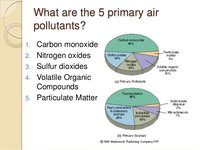
What is a primary pollutant that contributes to the formation of ozone in the atmosphere?
Carbon Dioxide
Nitrogen Oxides
Methane
Water Vapor
2.
MULTIPLE CHOICE QUESTION
30 sec • 1 pt
3.
MULTIPLE CHOICE QUESTION
30 sec • 1 pt
Explain how volatile organic compounds (VOCs) contribute to the formation of photochemical smog.
VOCs directly react with sulfur dioxide to form smog.
VOCs react with nitrogen oxides in the presence of sunlight to form ozone, a key component of smog.
VOCs are absorbed by plants, reducing smog formation.
VOCs neutralize acid rain, preventing smog.
4.
MULTIPLE CHOICE QUESTION
30 sec • 1 pt
It reacts with carbon dioxide to form carbonic acid.
It reacts with water vapor to form sulfuric acid.
It neutralizes nitric acid in the atmosphere.
It forms ozone when exposed to sunlight.
5.
MULTIPLE CHOICE QUESTION
30 sec • 1 pt
Describe the process by which photochemical smog is formed in urban areas.
Photochemical smog is formed when sulfur dioxide and water vapor react in the absence of sunlight.
Photochemical smog is formed when nitrogen oxides and volatile organic compounds react in the presence of sunlight, leading to the production of ozone and other pollutants.
Photochemical smog is formed when carbon monoxide and methane react in the presence of sunlight.
Photochemical smog is formed when particulate matter settles on the ground.
Access all questions and much more by creating a free account
Create resources
Host any resource
Get auto-graded reports

Continue with Google

Continue with Email

Continue with Classlink

Continue with Clever
or continue with

Microsoft
%20(1).png)
Apple

Others
Already have an account?
Similar Resources on Wayground
10 questions
EARTH'S ATMOSPHERIC LAYERS
Quiz
•
10th - 11th Grade
10 questions
Climate Change
Quiz
•
9th - 12th Grade
10 questions
Scientific Method and Graphing Review
Quiz
•
9th - 12th Grade
7 questions
M8L2 Review
Quiz
•
10th Grade
10 questions
Contaminación atmosférica
Quiz
•
1st - 10th Grade
9 questions
Science and Biology
Quiz
•
10th Grade
10 questions
Mixed Nomenclature
Quiz
•
10th Grade
7 questions
Sains Tingkatan 3 Bab 2 (2.1&2.2)
Quiz
•
4th - 12th Grade
Popular Resources on Wayground
15 questions
Fractions on a Number Line
Quiz
•
3rd Grade
20 questions
Equivalent Fractions
Quiz
•
3rd Grade
25 questions
Multiplication Facts
Quiz
•
5th Grade
54 questions
Analyzing Line Graphs & Tables
Quiz
•
4th Grade
22 questions
fractions
Quiz
•
3rd Grade
20 questions
Main Idea and Details
Quiz
•
5th Grade
20 questions
Context Clues
Quiz
•
6th Grade
15 questions
Equivalent Fractions
Quiz
•
4th Grade
Discover more resources for Science
10 questions
Exploring the Layers of the Earth

Interactive video
•
6th - 10th Grade
10 questions
Exploring Weathering, Erosion, and Deposition Processes
Interactive video
•
6th - 10th Grade
13 questions
Part 3 Review Protein Synthesis and Mutations
Quiz
•
10th Grade
22 questions
Earth's Spheres and Interactions Quiz Reveiw
Quiz
•
8th - 10th Grade
35 questions
DNA Structure and Replication
Quiz
•
10th Grade
20 questions
Phylogenetic Trees and Cladograms
Quiz
•
10th Grade
89 questions
Unit 1 (Ch 2 & 3) Test Review - Water/Ocean Currents
Quiz
•
9th - 12th Grade
10 questions
Natural Resources

Lesson
•
9th - 12th Grade