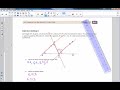
Angle Relationships and Triangle Properties

Interactive Video
•
Mathematics
•
6th - 8th Grade
•
Practice Problem
•
Hard

Thomas White
FREE Resource
Read more
10 questions
Show all answers
1.
MULTIPLE CHOICE QUESTION
30 sec • 1 pt
What is the sum of the interior angles in any triangle?
360 degrees
270 degrees
180 degrees
90 degrees
2.
MULTIPLE CHOICE QUESTION
30 sec • 1 pt
Which type of triangle has all angles less than 90 degrees?
Acute triangle
Obtuse triangle
Right triangle
Equilateral triangle
3.
MULTIPLE CHOICE QUESTION
30 sec • 1 pt
Why is it important to use three letters to name an angle at a vertex with multiple angles?
To follow alphabetical order
To make the name longer
To confuse the reader
To specify the exact angle being referred to
4.
MULTIPLE CHOICE QUESTION
30 sec • 1 pt
What are corresponding angles?
Angles on the same side of a transversal and parallel line
Angles on opposite sides of a transversal
Angles that are always obtuse
Angles that add up to 90 degrees
5.
MULTIPLE CHOICE QUESTION
30 sec • 1 pt
What property do corresponding angles have when lines are parallel?
They are equal to 90 degrees
They are supplementary
They are congruent
They are complementary
6.
MULTIPLE CHOICE QUESTION
30 sec • 1 pt
What are alternate interior angles?
Angles outside the parallel lines
Angles that are always equal to 180 degrees
Angles inside the parallel lines on opposite sides of a transversal
Angles on the same side of a transversal
7.
MULTIPLE CHOICE QUESTION
30 sec • 1 pt
How can alternate interior angles be proven congruent?
By rotating one angle 180 degrees around a midpoint
By adding them together
By measuring them
By using a protractor
Access all questions and much more by creating a free account
Create resources
Host any resource
Get auto-graded reports

Continue with Google

Continue with Email

Continue with Classlink

Continue with Clever
or continue with

Microsoft
%20(1).png)
Apple

Others
Already have an account?
Popular Resources on Wayground

7 questions
History of Valentine's Day
Interactive video
•
4th Grade
15 questions
Fractions on a Number Line

Quiz
•
3rd Grade
20 questions
Equivalent Fractions
Quiz
•
3rd Grade
25 questions
Multiplication Facts
Quiz
•
5th Grade
22 questions
fractions
Quiz
•
3rd Grade
15 questions
Valentine's Day Trivia
Quiz
•
3rd Grade
20 questions
Main Idea and Details
Quiz
•
5th Grade
20 questions
Context Clues
Quiz
•
6th Grade
Discover more resources for Mathematics
20 questions
Writing Algebraic Expressions
Quiz
•
6th Grade
20 questions
Ratios/Rates and Unit Rates
Quiz
•
6th Grade
14 questions
Volume of rectangular prisms
Quiz
•
7th Grade
20 questions
Laws of Exponents
Quiz
•
8th Grade
20 questions
Graphing Inequalities on a Number Line
Quiz
•
6th - 9th Grade
20 questions
One Step Equations
Quiz
•
6th Grade
10 questions
Solving One Step Inequalities
Quiz
•
6th Grade
15 questions
Equivalent Ratios
Quiz
•
6th Grade