
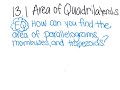
Area and Properties of Quadrilaterals

Interactive Video
•
Mathematics
•
5th - 6th Grade
•
Practice Problem
•
Hard
Thomas White
FREE Resource
Read more
10 questions
Show all answers
1.
MULTIPLE CHOICE QUESTION
30 sec • 1 pt
What is the essential question discussed in this lesson?
How to find the area of parallelograms, rhombuses, and trapezoids?
How to find the perimeter of quadrilaterals?
How to determine the angles in a triangle?
How to calculate the volume of 3D shapes?
2.
MULTIPLE CHOICE QUESTION
30 sec • 1 pt
Which formula is used to calculate the area of a parallelogram?
Area = base × base
Area = base × height
Area = base + height
Area = 1/2 × base × height
3.
MULTIPLE CHOICE QUESTION
30 sec • 1 pt
If a parallelogram has a base of 14 cm and a height of 7 cm, what is its area?
98 cm²
196 cm²
21 cm²
49 cm²
4.
MULTIPLE CHOICE QUESTION
30 sec • 1 pt
What is the formula for finding the area of a trapezoid?
Area = base1 + base2
Area = height × (base1 + base2)
Area = 1/2 × height × (base1 + base2)
Area = base1 × base2
5.
MULTIPLE CHOICE QUESTION
30 sec • 1 pt
In the formula for the area of a trapezoid, what does the '1/2' represent?
It is used to convert the height to a base.
It represents the average of the two bases.
It is a constant to adjust for the shape's symmetry.
It is a placeholder for additional calculations.
6.
MULTIPLE CHOICE QUESTION
30 sec • 1 pt
Calculate the area of a trapezoid with bases of 17 ft and 39 ft, and a height of 16 ft.
224 ft²
336 ft²
672 ft²
448 ft²
7.
MULTIPLE CHOICE QUESTION
30 sec • 1 pt
What is unique about the sides of a rhombus?
All sides are different.
All sides are perpendicular.
All sides are congruent.
All sides are parallel.
Access all questions and much more by creating a free account
Create resources
Host any resource
Get auto-graded reports

Continue with Google

Continue with Email

Continue with Classlink

Continue with Clever
or continue with

Microsoft
%20(1).png)
Apple

Others
Already have an account?

