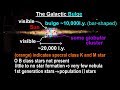
Galactic Structures and Star Formation

Interactive Video
•
Science
•
9th - 10th Grade
•
Practice Problem
•
Hard

Patricia Brown
FREE Resource
Read more
10 questions
Show all answers
1.
MULTIPLE CHOICE QUESTION
30 sec • 1 pt
What is the primary difference in shape between the Milky Way and Andromeda galaxies' bulges?
The Milky Way has a bar-shaped bulge, while Andromeda has a spherical bulge.
The Milky Way has a spherical bulge, while Andromeda has a bar-shaped bulge.
Both have spherical bulges.
Both have bar-shaped bulges.
2.
MULTIPLE CHOICE QUESTION
30 sec • 1 pt
Why do the spiral arms of the galaxy appear bluish?
Due to the presence of red giants.
Because of the formation of bright blue giant stars.
Because of the presence of dust clouds.
Due to the absence of star formation.
3.
MULTIPLE CHOICE QUESTION
30 sec • 1 pt
What type of stars are predominantly found in the Galactic Bulge?
Young O and B type stars.
First-generation stars with mostly hydrogen and helium.
Newly formed stars with heavy elements.
Stars with a high metal content.
4.
MULTIPLE CHOICE QUESTION
30 sec • 1 pt
What is a characteristic feature of first-generation stars in the Galactic Bulge?
They contain a high percentage of heavy elements.
They are mostly composed of hydrogen and helium.
They are younger than population one stars.
They are primarily found in the spiral arms.
5.
MULTIPLE CHOICE QUESTION
30 sec • 1 pt
Why is it difficult to observe the center of the Galactic Bulge?
Because it is too far away.
Due to the high density of stars and interstellar dust.
Because it is not bright enough.
Due to interference from other galaxies.
6.
MULTIPLE CHOICE QUESTION
30 sec • 1 pt
What is the main reason the Galactic Bulge appears as a dense region?
It is filled with dark matter.
It has a high density of older stars.
It is surrounded by a thick layer of gas.
It contains a large number of young stars.
7.
MULTIPLE CHOICE QUESTION
30 sec • 1 pt
What is the future prediction for star formation in galaxies?
Galaxies will continue to form new stars indefinitely.
Star formation will only stop in elliptical galaxies.
Star formation will eventually cease in all galaxies.
Star formation will increase over time.
Access all questions and much more by creating a free account
Create resources
Host any resource
Get auto-graded reports

Continue with Google

Continue with Email

Continue with Classlink

Continue with Clever
or continue with

Microsoft
%20(1).png)
Apple

Others
Already have an account?
Similar Resources on Wayground

6 questions
CLEAN : Portugal ex PM leaves jail for house arrest
Interactive video
•
9th - 10th Grade
11 questions
Flying Cars and the Future of Transportation
Interactive video
•
9th - 12th Grade
6 questions
Understanding 'I Carry Your Heart with Me'
Interactive video
•
9th - 12th Grade
2 questions
GettyImages Celebrity News - 03/04/13
Interactive video
•
9th - 10th Grade
2 questions
CLEAN : Star Trek's Patrick Stewart honored on Hollywood Boulevard
Interactive video
•
9th - 10th Grade
8 questions
Basic Grammar - the Simple Present
Interactive video
•
10th - 12th Grade
11 questions
Understanding the Sixth Amendment
Interactive video
•
9th - 12th Grade
Popular Resources on Wayground
15 questions
Fractions on a Number Line

Quiz
•
3rd Grade
20 questions
Equivalent Fractions
Quiz
•
3rd Grade
25 questions
Multiplication Facts
Quiz
•
5th Grade
54 questions
Analyzing Line Graphs & Tables
Quiz
•
4th Grade
22 questions
fractions
Quiz
•
3rd Grade
20 questions
Main Idea and Details
Quiz
•
5th Grade
20 questions
Context Clues
Quiz
•
6th Grade
15 questions
Equivalent Fractions
Quiz
•
4th Grade
Discover more resources for Science
10 questions
Exploring the Layers of the Earth
Interactive video
•
6th - 10th Grade
25 questions
Naming Ionic and Covalent Compounds
Quiz
•
9th Grade
20 questions
Mendelian Genetics Review
Quiz
•
9th Grade
10 questions
Exploring Weathering, Erosion, and Deposition Processes
Interactive video
•
6th - 10th Grade
21 questions
Evidence of Evolution
Quiz
•
9th Grade
13 questions
Part 3 Review Protein Synthesis and Mutations
Quiz
•
10th Grade
22 questions
Earth's Spheres and Interactions Quiz Reveiw
Quiz
•
8th - 10th Grade
15 questions
Genetics- Punnett Squares
Quiz
•
9th Grade