
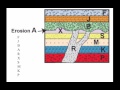
Geological Principles and Dating Methods

Interactive Video
•
Science
•
9th - 10th Grade
•
Practice Problem
•
Hard

Patricia Brown
FREE Resource
Read more
10 questions
Show all answers
1.
MULTIPLE CHOICE QUESTION
30 sec • 1 pt
What is the main difference between relative and absolute dating?
Relative dating provides a specific age, while absolute dating only determines older or younger.
Relative dating determines the sequence of events, while absolute dating provides a numerical age.
Relative dating is more accurate than absolute dating.
Absolute dating is only used for rocks, while relative dating is used for fossils.
2.
MULTIPLE CHOICE QUESTION
30 sec • 1 pt
Who was Nicholas Steno, and what was his contribution to geology?
An English geologist who discovered the principle of uniformitarianism.
A French naturalist who introduced the concept of extinction.
A Catholic priest who proposed the laws of stratigraphy.
A Danish scientist who developed the theory of plate tectonics.
3.
MULTIPLE CHOICE QUESTION
30 sec • 1 pt
According to the law of superposition, which rock layer is the oldest?
The layer in the middle.
The layer with the most fossils.
The layer at the top.
The layer at the bottom.
4.
MULTIPLE CHOICE QUESTION
30 sec • 1 pt
What does the principle of original horizontality state?
Rock layers are originally deposited in a circular pattern.
Rock layers are originally deposited horizontally.
Rock layers are originally deposited at an angle.
Rock layers are originally deposited vertically.
5.
MULTIPLE CHOICE QUESTION
30 sec • 1 pt
How does the principle of cross-cutting relationships help in dating rock layers?
It states that the oldest layer is always on top.
It indicates that the cutting feature is older than the layers it cuts through.
It shows that the cutting feature is younger than the layers it cuts through.
It suggests that all layers are the same age.
6.
MULTIPLE CHOICE QUESTION
30 sec • 1 pt
In the context of stratigraphy, what is an unconformity?
A continuous sequence of rock layers.
A gap in the geological record indicating erosion or non-deposition.
A type of rock layer that is always the oldest.
A feature that indicates volcanic activity.
7.
MULTIPLE CHOICE QUESTION
30 sec • 1 pt
Which law would you use to determine the relative age of a rock layer containing fragments of another rock?
Principle of Cross-Cutting Relationships
Law of Inclusions
Principle of Original Horizontality
Law of Superposition
Access all questions and much more by creating a free account
Create resources
Host any resource
Get auto-graded reports

Continue with Google

Continue with Email

Continue with Classlink

Continue with Clever
or continue with

Microsoft
%20(1).png)
Apple

Others
Already have an account?
Similar Resources on Wayground
Popular Resources on Wayground

15 questions
Fractions on a Number Line

Quiz
•
3rd Grade
10 questions
Probability Practice
Quiz
•
4th Grade
15 questions
Probability on Number LIne
Quiz
•
4th Grade
20 questions
Equivalent Fractions
Quiz
•
3rd Grade
25 questions
Multiplication Facts
Quiz
•
5th Grade
22 questions
fractions
Quiz
•
3rd Grade
6 questions
Appropriate Chromebook Usage

Lesson
•
7th Grade
10 questions
Greek Bases tele and phon
Quiz
•
6th - 8th Grade
Discover more resources for Science
25 questions
Naming Ionic and Covalent Compounds
Quiz
•
9th Grade
10 questions
Exploring Weathering, Erosion, and Deposition Processes
Interactive video
•
6th - 10th Grade
26 questions
Unit 8b Review
Quiz
•
9th Grade
14 questions
Natural Selection and Adaptation
Lesson
•
9th - 12th Grade
10 questions
Exploring Water Pollution and Conservation
Interactive video
•
6th - 10th Grade
10 questions
Exploring the Human Respiratory System
Interactive video
•
6th - 10th Grade
30 questions
Unit 2C Progress Check (Biosphere 3)
Quiz
•
9th - 12th Grade
14 questions
Genetics Practice (Mendelian & Non-mendelian)
Quiz
•
10th Grade