
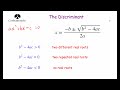
Quadratic Equations and Discriminants

Interactive Video
•
Mathematics
•
9th - 10th Grade
•
Practice Problem
•
Hard

Thomas White
FREE Resource
Read more
10 questions
Show all answers
1.
MULTIPLE CHOICE QUESTION
30 sec • 1 pt
What is the discriminant in the quadratic formula?
b^2 - 2ac
b^2 + 2ac
b^2 - 4ac
b^2 + 4ac
2.
MULTIPLE CHOICE QUESTION
30 sec • 1 pt
If the discriminant is positive, what does it indicate about the roots of the quadratic equation?
No real roots
Complex roots
Two different real roots
One repeated real root
3.
MULTIPLE CHOICE QUESTION
30 sec • 1 pt
How does the graph of a quadratic equation behave when the discriminant is zero?
Crosses the x-axis at two points
Touches the x-axis at one point
Does not touch the x-axis
Forms a straight line
4.
MULTIPLE CHOICE QUESTION
30 sec • 1 pt
What is the value of k for which the equation x^2 + kx + 16 = 0 has equal roots?
k = 16
k = 8
k = 4
k = 0
5.
MULTIPLE CHOICE QUESTION
30 sec • 1 pt
For the equation x^2 + 3x + k = 0 to have two unique real roots, what must be true about k?
k = 0
k > 9/4
k < 9/4
k = 9/4
6.
MULTIPLE CHOICE QUESTION
30 sec • 1 pt
What condition must be met for a quadratic equation to have no real roots?
Discriminant is zero
Discriminant is negative
Discriminant is undefined
Discriminant is positive
7.
MULTIPLE CHOICE QUESTION
30 sec • 1 pt
In the equation 3x^2 - 2x - (k + 1) = 0, what is the condition for no real roots?
k = 0
k = -4/3
k < -4/3
k > -4/3
Access all questions and much more by creating a free account
Create resources
Host any resource
Get auto-graded reports

Continue with Google

Continue with Email

Continue with Classlink

Continue with Clever
or continue with

Microsoft
%20(1).png)
Apple

Others
Already have an account?

