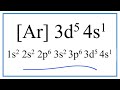
Chromium's Electron Configuration Concepts

Interactive Video
•
Chemistry
•
9th - 10th Grade
•
Practice Problem
•
Hard

Olivia Brooks
FREE Resource
Read more
10 questions
Show all answers
1.
MULTIPLE CHOICE QUESTION
30 sec • 1 pt
What is the electron configuration that ends in 3d5 4s1 used to identify?
The element with atomic number 24
The element with atomic number 26
The element with atomic number 30
The element with atomic number 28
2.
MULTIPLE CHOICE QUESTION
30 sec • 1 pt
How many electrons are present in the electron configuration discussed in the video?
23
25
22
24
3.
MULTIPLE CHOICE QUESTION
30 sec • 1 pt
What does the atomic number of an element represent?
The number of isotopes
The number of protons
The number of electrons
The number of neutrons
4.
MULTIPLE CHOICE QUESTION
30 sec • 1 pt
What does the neutrality of an element imply about its electrons and protons?
Electrons are more than protons
Neutrons equal protons
Protons are more than electrons
Electrons equal protons
5.
MULTIPLE CHOICE QUESTION
30 sec • 1 pt
Why is chromium's electron configuration considered exceptional?
It has more electrons than expected
It has fewer protons than expected
It has a different arrangement of electrons than expected
It has a different number of neutrons than expected
6.
MULTIPLE CHOICE QUESTION
30 sec • 1 pt
What is the expected electron configuration for chromium?
4s1 3d5
4s1 3d4
4s2 3d4
4s2 3d5
7.
MULTIPLE CHOICE QUESTION
30 sec • 1 pt
What is the significance of the 4s and 3d orbitals in chromium's configuration?
The 3d orbital is always filled before the 4s orbital
The 4s orbital is filled after the 3d orbital in chromium
The 4s orbital is always filled before the 3d orbital
The 3d orbital is filled after the 4s orbital in chromium
Access all questions and much more by creating a free account
Create resources
Host any resource
Get auto-graded reports

Continue with Google

Continue with Email

Continue with Classlink

Continue with Clever
or continue with

Microsoft
%20(1).png)
Apple

Others
Already have an account?
Similar Resources on Wayground

6 questions
GCSE Chemistry - Oxidation and Reduction - Redox Reactions #39 (Higher Tier)
Interactive video
•
9th - 10th Grade
11 questions
Electronegativity and Bond Character Quiz
Interactive video
•
9th - 10th Grade
11 questions
Understanding Molecular Polarity
Interactive video
•
9th - 10th Grade
11 questions
Understanding Atoms, Isotopes, and Ions
Interactive video
•
9th - 10th Grade
11 questions
Understanding Periodic Table Trends
Interactive video
•
9th - 10th Grade
11 questions
Electronegativity and Bond Character Quiz
Interactive video
•
9th - 10th Grade
11 questions
Understanding the Periodic Table: Groups, Periods, and Reactivity
Interactive video
•
9th - 10th Grade
6 questions
Understanding Quantum Physics and Identity
Interactive video
•
9th - 10th Grade
Popular Resources on Wayground
7 questions
History of Valentine's Day
Interactive video
•
4th Grade
15 questions
Fractions on a Number Line

Quiz
•
3rd Grade
20 questions
Equivalent Fractions
Quiz
•
3rd Grade
25 questions
Multiplication Facts
Quiz
•
5th Grade
22 questions
fractions
Quiz
•
3rd Grade
15 questions
Valentine's Day Trivia
Quiz
•
3rd Grade
20 questions
Main Idea and Details
Quiz
•
5th Grade
20 questions
Context Clues
Quiz
•
6th Grade
Discover more resources for Chemistry
25 questions
Unit 8 Stoichiometry Review
Quiz
•
10th Grade
20 questions
Types of Chemical Reactions
Quiz
•
9th - 12th Grade
19 questions
Stoichiometry, Limiting Reactants, and Percent Yield
Quiz
•
10th Grade
10 questions
Formative 3BD: Ionic Bonds
Quiz
•
9th Grade
15 questions
Balancing Chemical Equations
Quiz
•
10th - 12th Grade
20 questions
Naming & Writing Chemical Formulas
Quiz
•
10th Grade
10 questions
Identifying types of reactions
Quiz
•
9th - 12th Grade
20 questions
Periodic Trends
Quiz
•
10th Grade