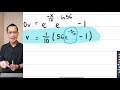
Understanding Exponential Decay Models

Interactive Video
•
Physics
•
11th - 12th Grade
•
Practice Problem
•
Hard

Emma Peterson
FREE Resource
Read more
10 questions
Show all answers
1.
MULTIPLE CHOICE QUESTION
30 sec • 1 pt
What is the initial step taken to simplify the force equation?
Treating mass as a constant
Ignoring acceleration
Treating mass as a variable
Assuming velocity is constant
2.
MULTIPLE CHOICE QUESTION
30 sec • 1 pt
Which form of acceleration is chosen for efficiency in this problem?
d^2x/dt^2
d/dx of half v^2
v dv/dx
d/dt of v
3.
MULTIPLE CHOICE QUESTION
30 sec • 1 pt
What is the purpose of separating variables in this context?
To simplify the equation
To eliminate velocity
To find acceleration
To prepare for integration
4.
MULTIPLE CHOICE QUESTION
30 sec • 1 pt
What mathematical operation is performed after separating variables?
Differentiation
Subtraction
Multiplication
Integration
5.
MULTIPLE CHOICE QUESTION
30 sec • 1 pt
How is the constant of integration determined?
By setting velocity to zero
Using initial conditions
By differentiating the equation
By assuming it is zero
6.
MULTIPLE CHOICE QUESTION
30 sec • 1 pt
What type of model is derived from the integration process?
Linear growth model
Exponential decay model
Quadratic model
Logarithmic model
7.
MULTIPLE CHOICE QUESTION
30 sec • 1 pt
What does the exponential decay model imply about the boat's velocity?
Velocity oscillates
Velocity decreases over time
Velocity increases over time
Velocity remains constant
Access all questions and much more by creating a free account
Create resources
Host any resource
Get auto-graded reports

Continue with Google

Continue with Email

Continue with Classlink

Continue with Clever
or continue with

Microsoft
%20(1).png)
Apple

Others
Already have an account?
Similar Resources on Wayground

6 questions
Learn how to find the equation of a parabola given the vertex through a point
Interactive video
•
11th Grade - University
6 questions
How to apply the 2nd ftc with secant squared
Interactive video
•
11th Grade - University
8 questions
Fluids in Motion: Crash Course Physics
Interactive video
•
11th Grade - University
8 questions
Exponential Equation | Can you Solve?
Interactive video
•
11th Grade - University
8 questions
Big Ideas - Episode 13 - Search For New Planets
Interactive video
•
KG - University
8 questions
Political Ideology: Crash Course Government and Politics #35
Interactive video
•
11th Grade - University
11 questions
Practical - Force and Acceleration
Interactive video
•
10th Grade - University
6 questions
How to Find a Humpback Whale
Interactive video
•
10th - 12th Grade
Popular Resources on Wayground
15 questions
Fractions on a Number Line

Quiz
•
3rd Grade
20 questions
Equivalent Fractions
Quiz
•
3rd Grade
25 questions
Multiplication Facts
Quiz
•
5th Grade
54 questions
Analyzing Line Graphs & Tables
Quiz
•
4th Grade
22 questions
fractions
Quiz
•
3rd Grade
20 questions
Main Idea and Details
Quiz
•
5th Grade
20 questions
Context Clues
Quiz
•
6th Grade
15 questions
Equivalent Fractions
Quiz
•
4th Grade
